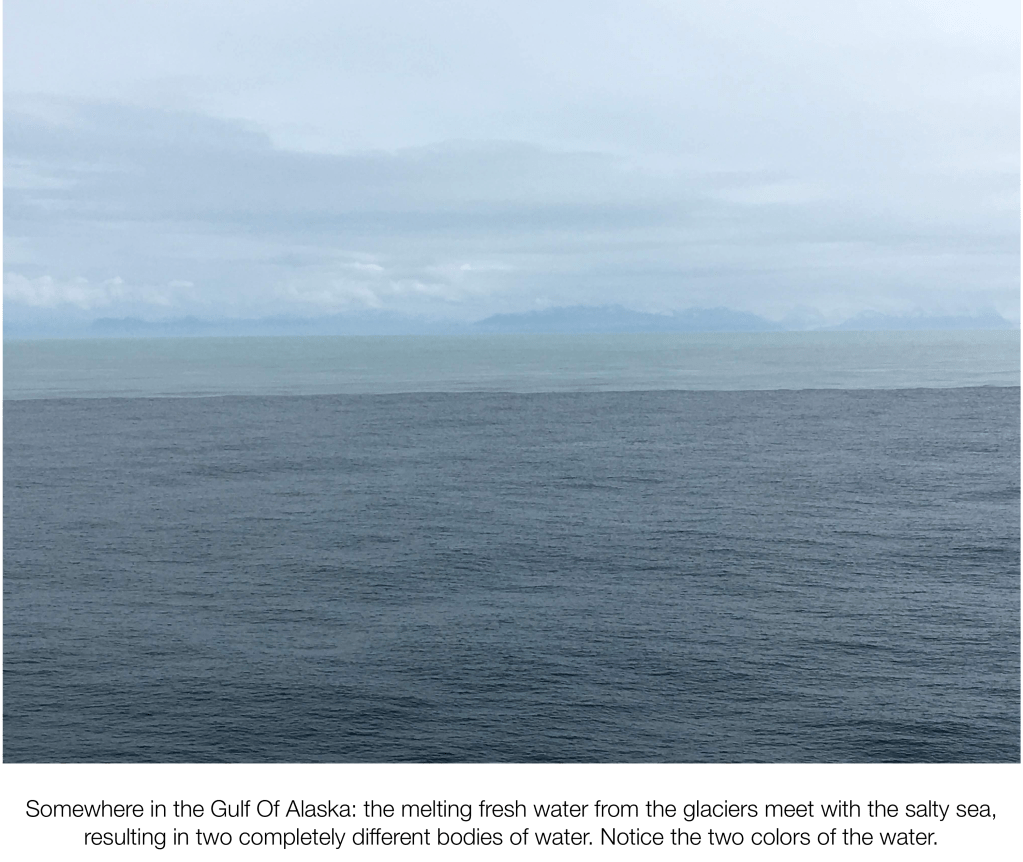
The Trip Of A Life Time- The Summer That Could Have Been Idyllic

The summer of 2018 dawned bright with the beginning of a beautiful summer. I had just turned 50. My eldest daughter graduated salutatorian from high school in May and was about to turn 18. As a gift for these momentous occasions, my mother offered to take my family on the trip of a life time. Four years ago, in late June, off we went: a trip that seemed like the beginning of an idyllic summer. Travel with me to the great Northwest, as I traveled 4 summers ago:

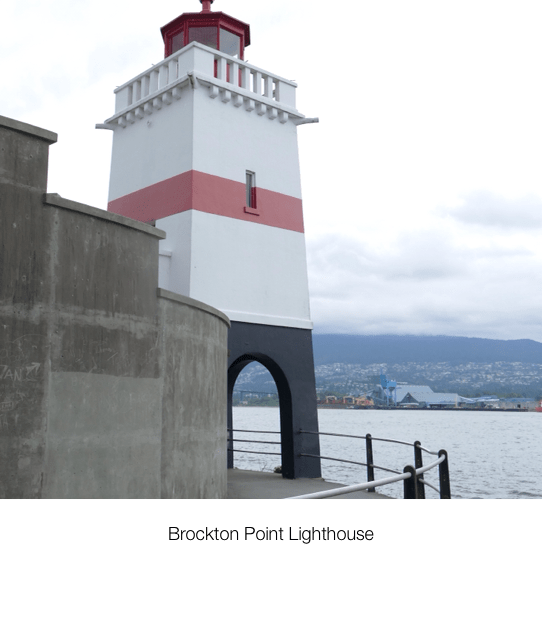
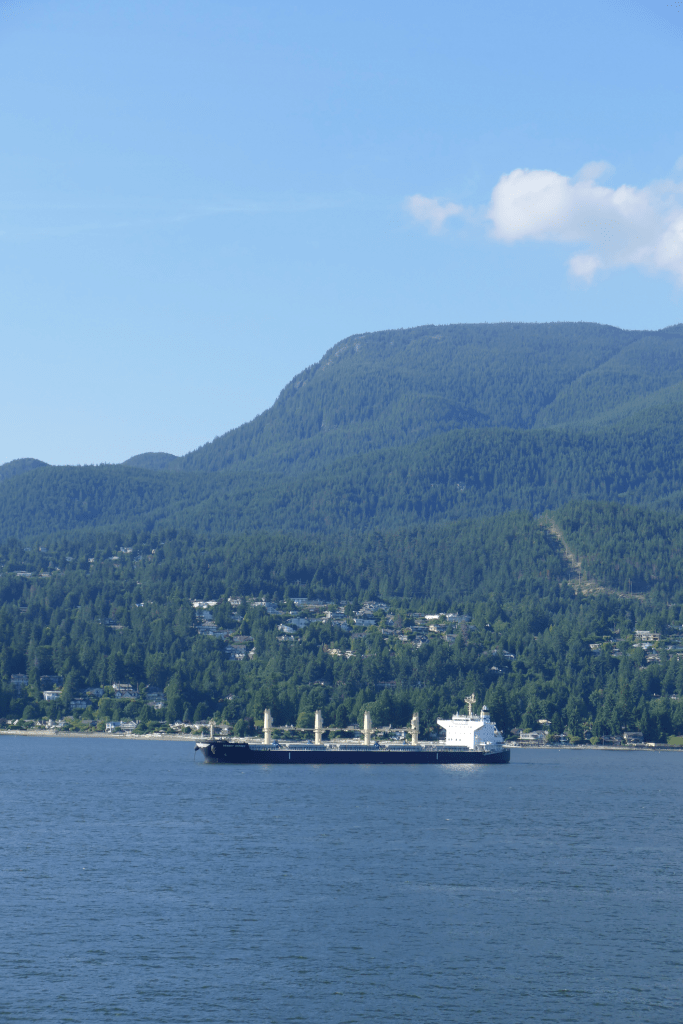
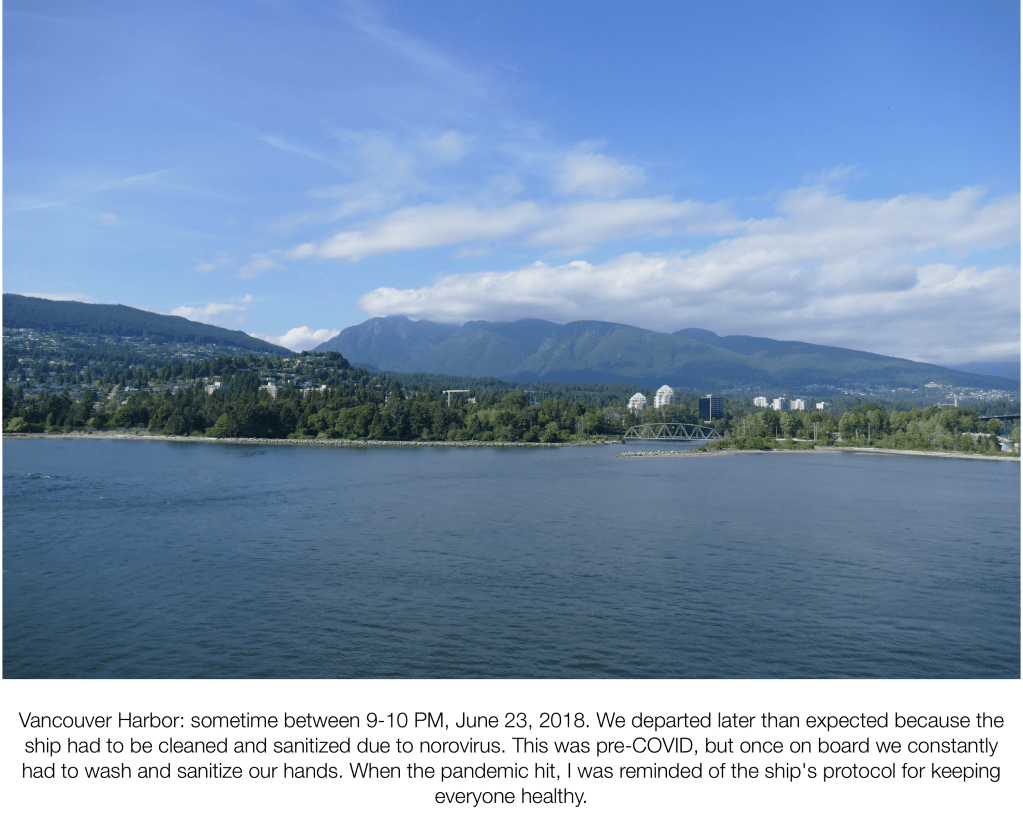
Vancouver, British Columbia

In late June my family joined my mother and her partner in Vancouver; there were seven of us in all. We spent a few days seeing some of the city, before embarking on a cruise to Alaska.

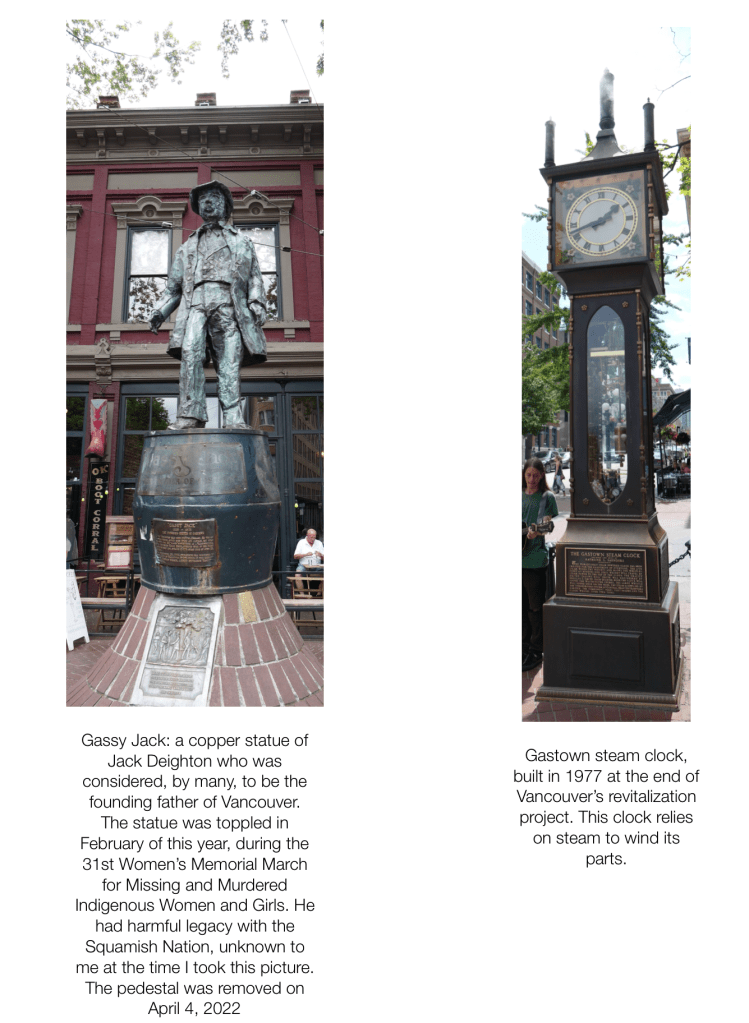
Gastown: Vancouver’s oldest neighborhood and original settlement
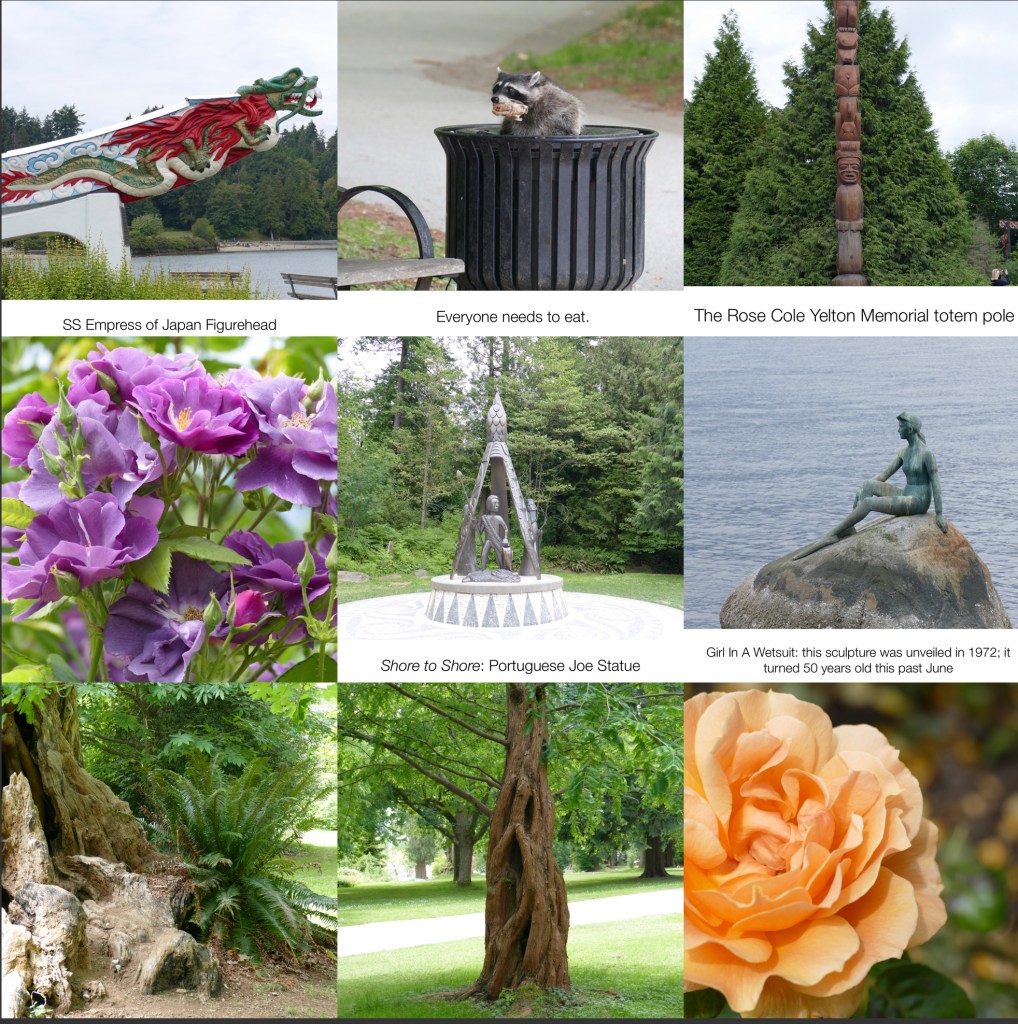
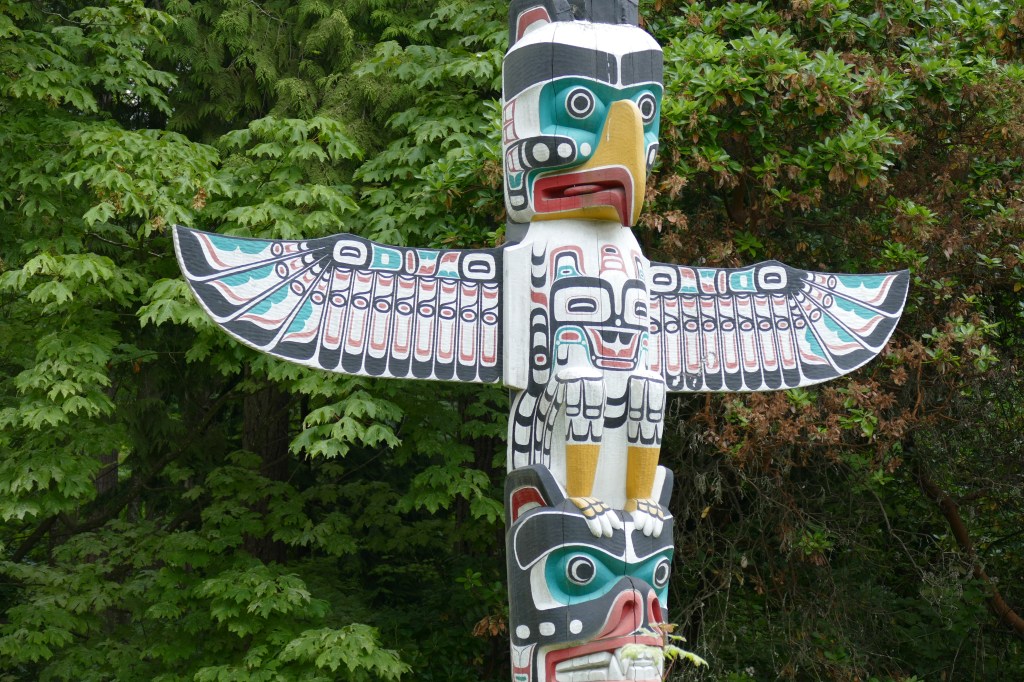
Stanley Park
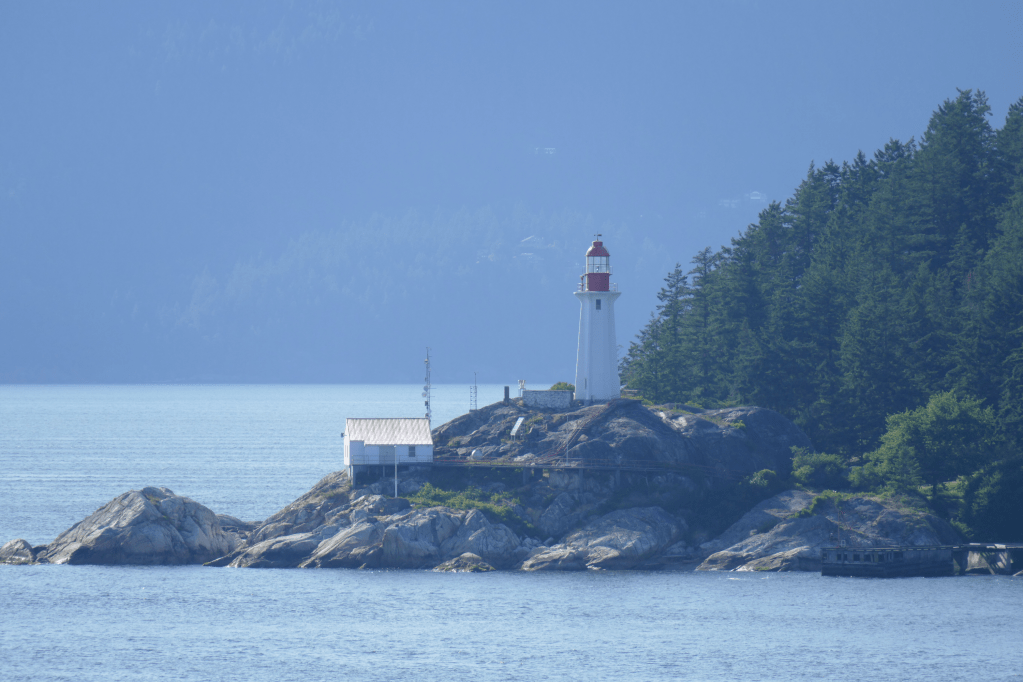
On Board The Star Princess: the beginning of our Alaska cruise and land tour
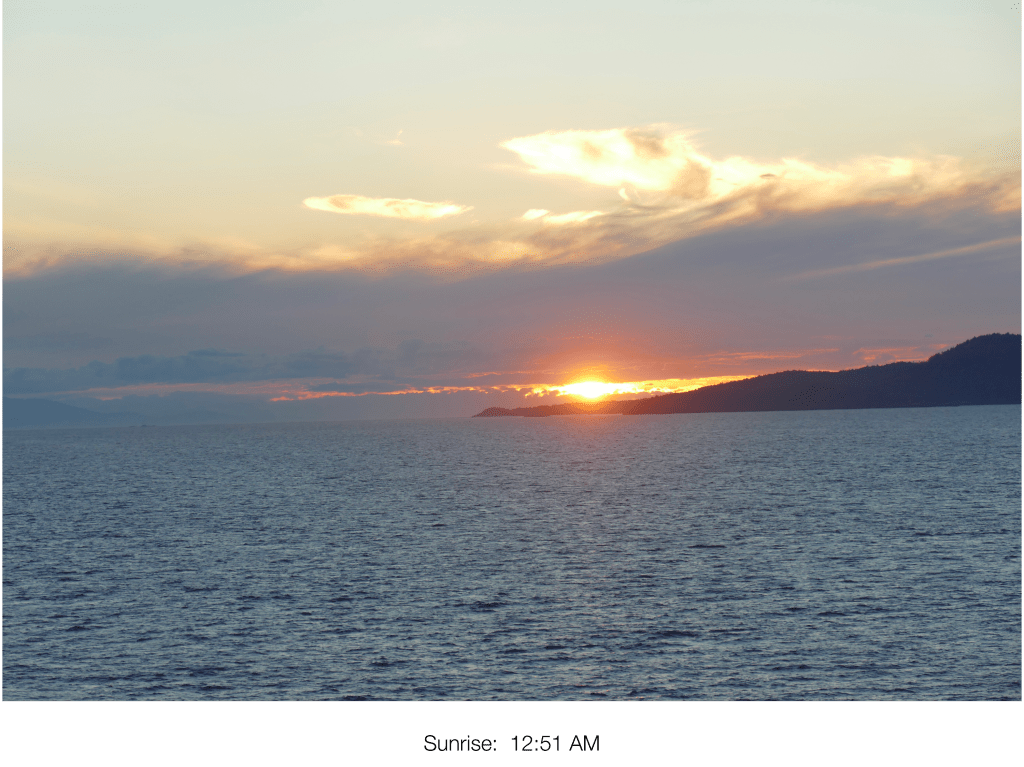
Traveling to The Land of the Midnight Sun
 

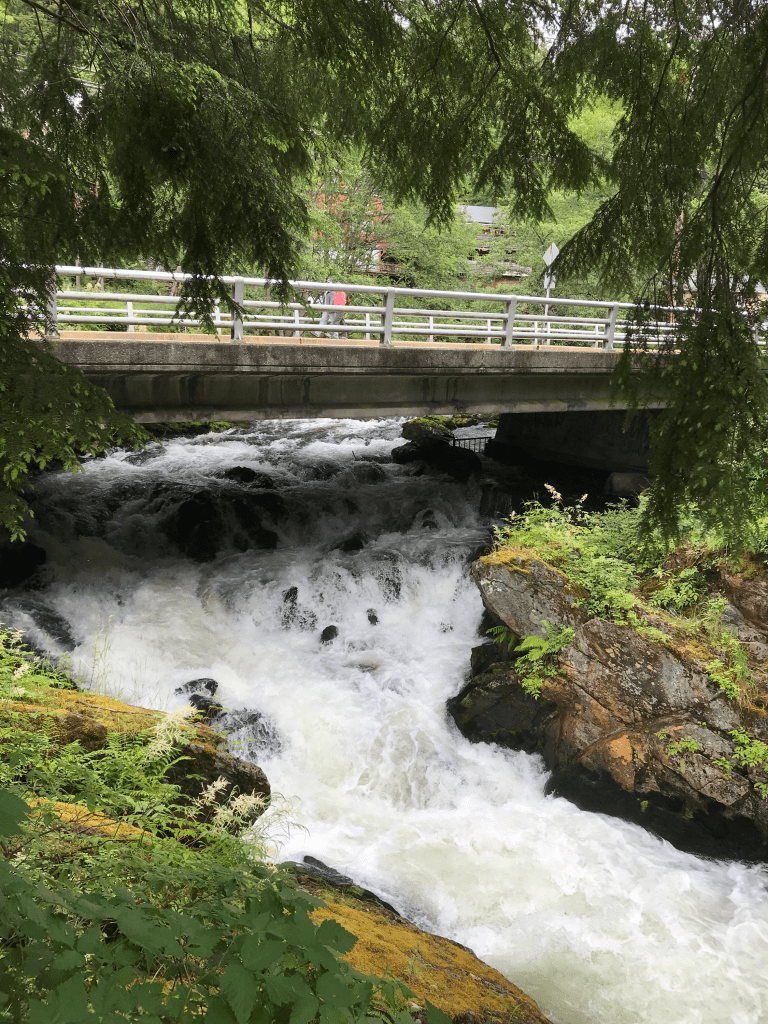
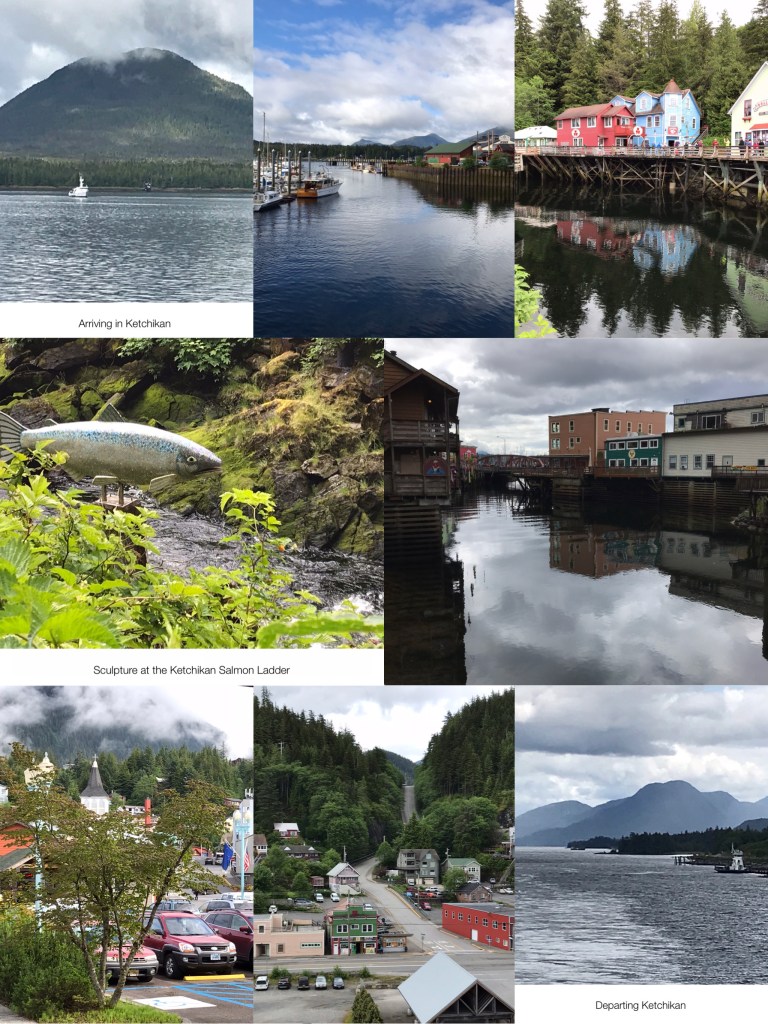
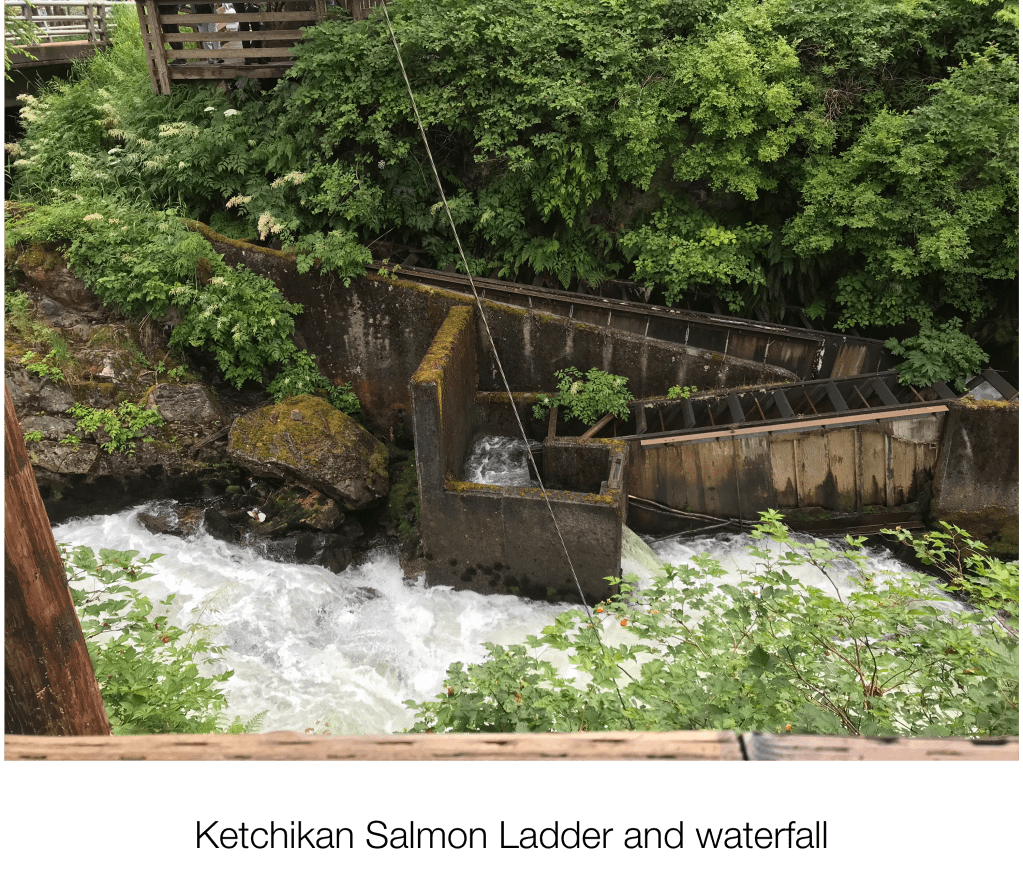
Ketchikan, our first stop, was founded as a salmon cannery site. Of the three ports of call, the time in this city was the shortest. Our time ashore was spent walking around the city, visiting the Totem Heritage Center and seeing the Ketchikan Salmon Ladder and waterfall.
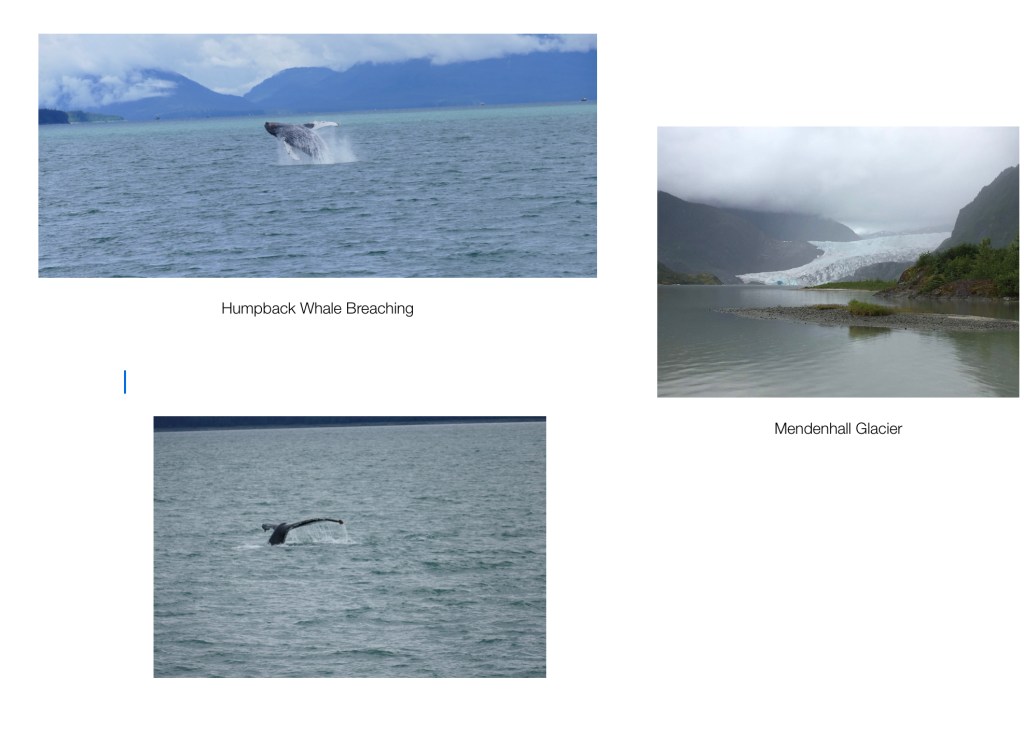
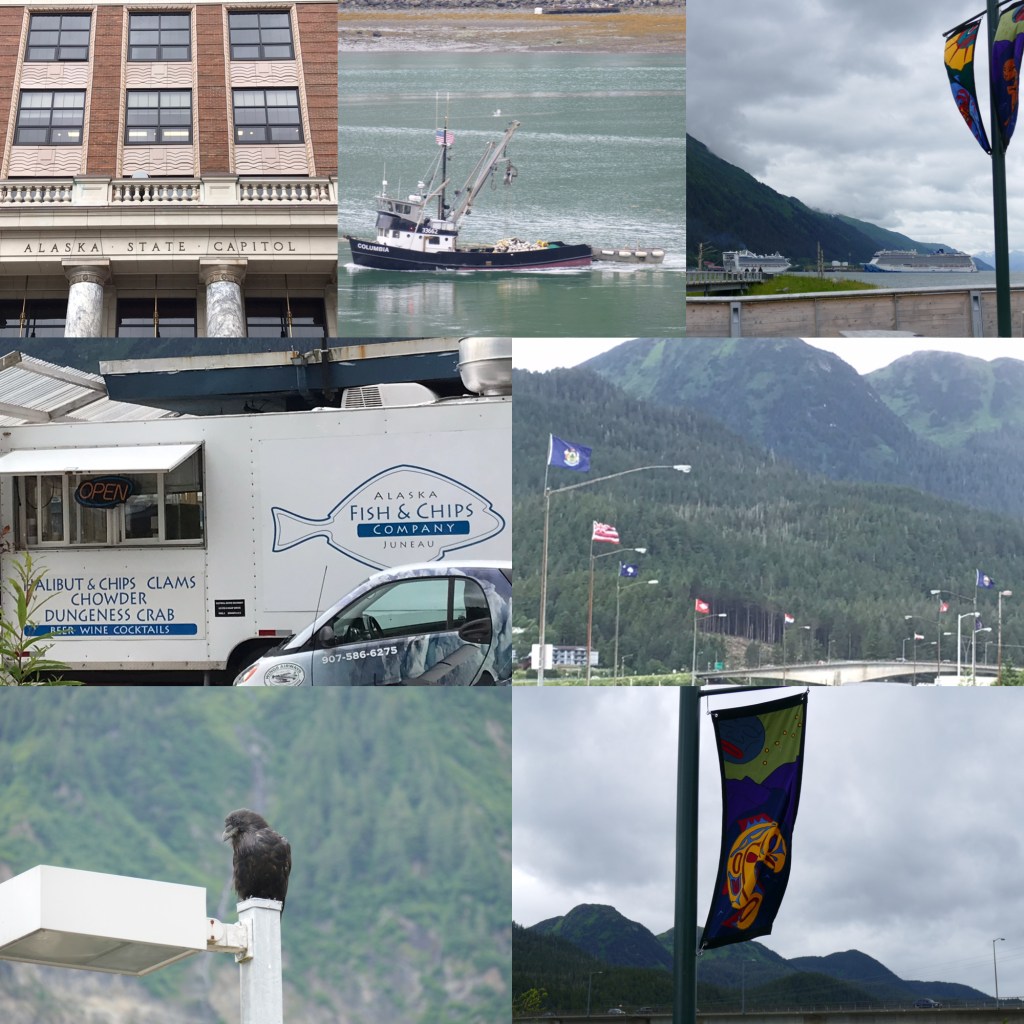
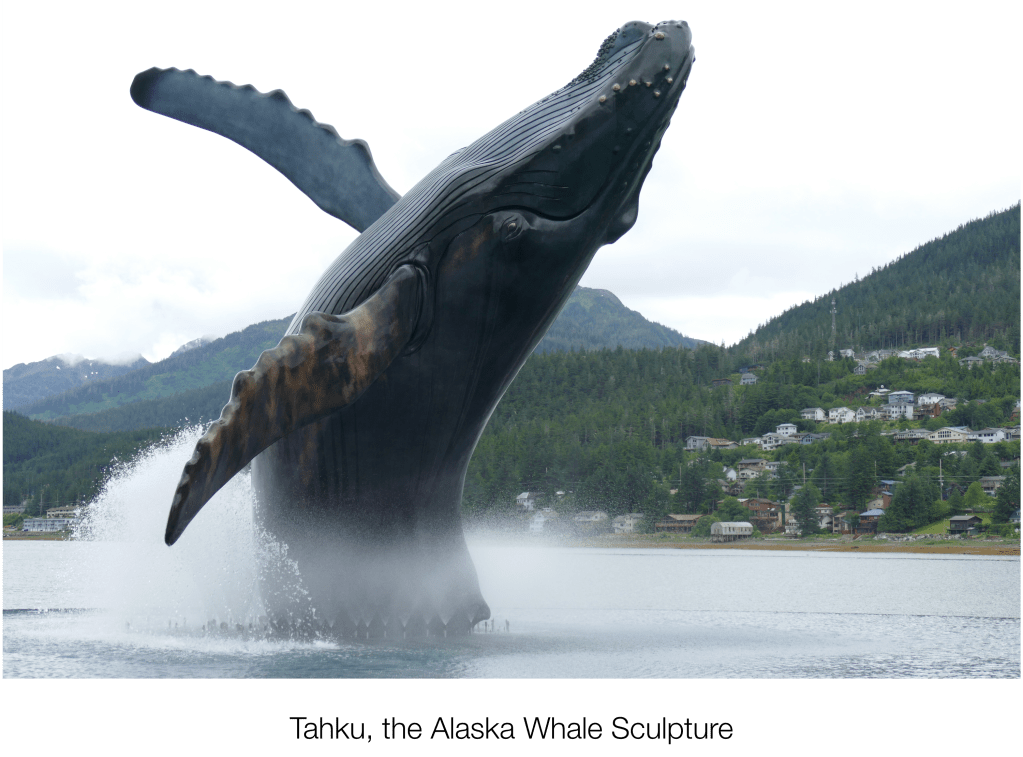
Juneau was the second port of call. We passed the morning hours walking around the capital city of Alaska….Someone, perhaps in the visitors center, told us to go to a waterfront park where there was a sculpture of a whale in an infinity pool; for me that was the pinnacle of our morning.
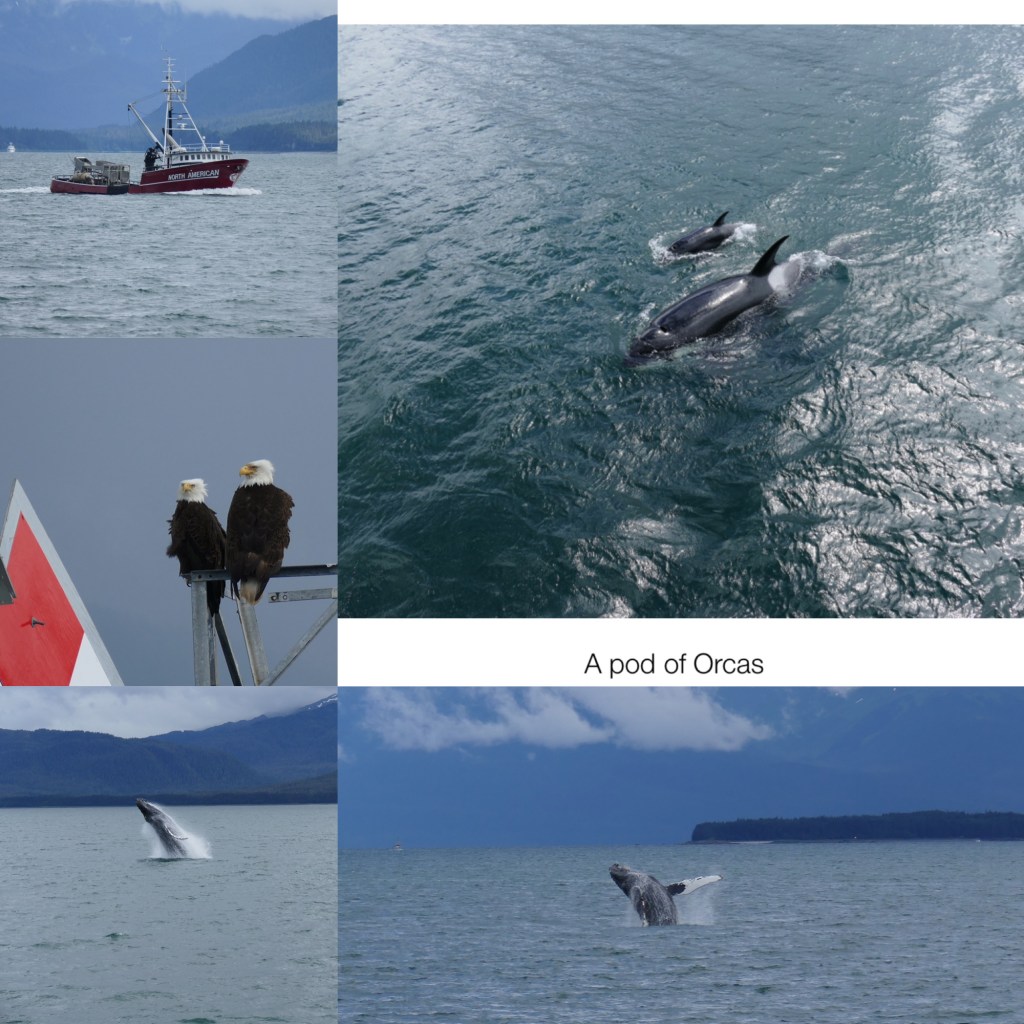
The afternoon was spent on a Whale Watching and Mendenhall Glacier tour:
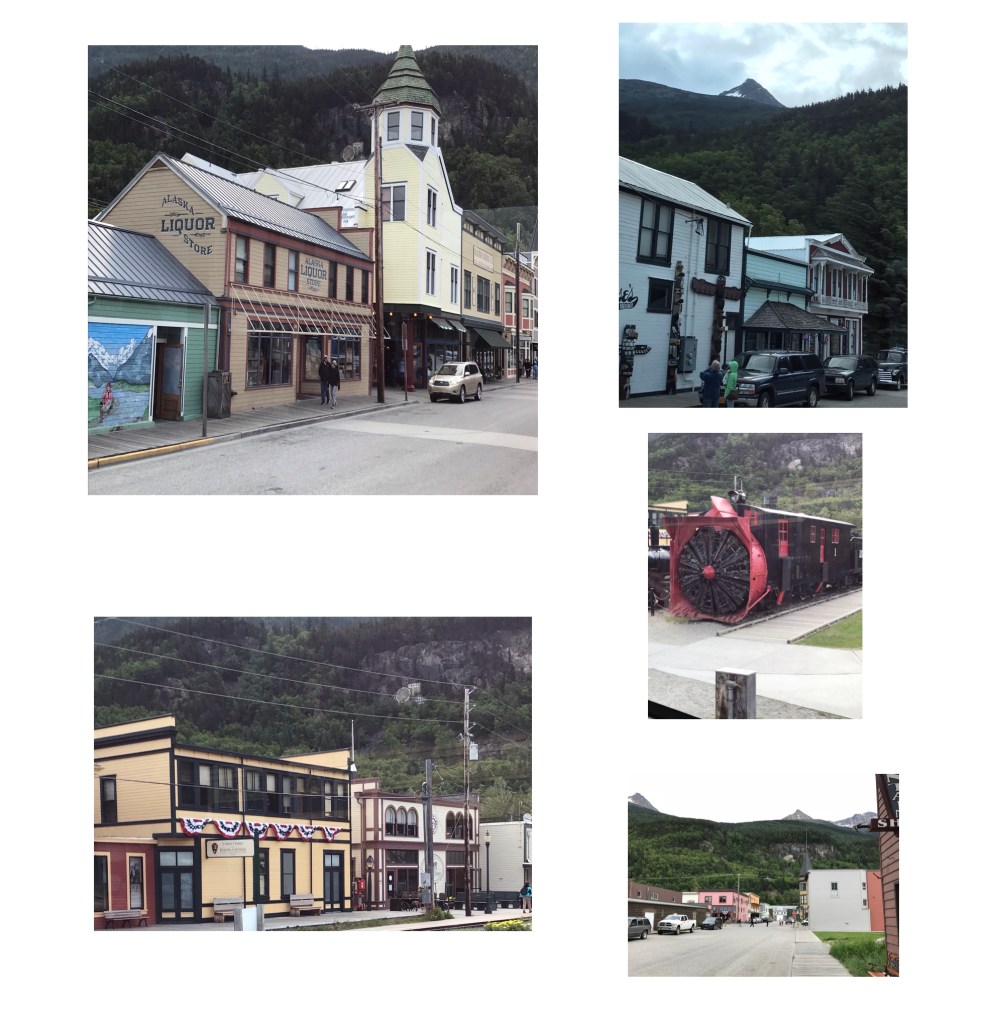
Skagway, our third and final port of call, is known as a town of the gold rush era because it is a gateway to the Klondike gold fields.

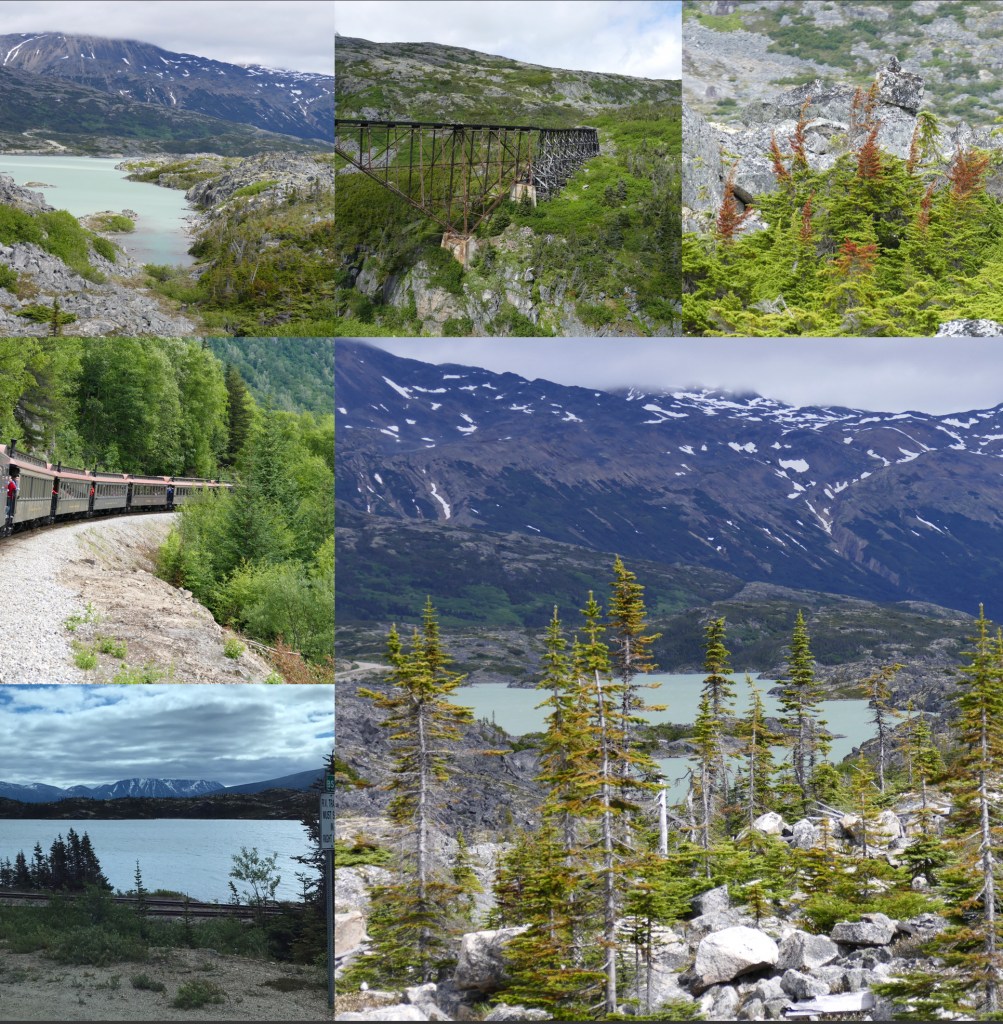
An amazing tour was taken from Skagway, by bus and railway. We had a fabulous tour guide named Bruce Schindler; he came to Skagway one summer, from Washington State, to be a guide on a tour bus and basically stayed. I mention Bruce, not only because he was such a great tour guide, but also because guiding tours was rare for him at the time. We were lucky to have him give us our tour. He had become an artist, creating sculptures and carvings out of mammoth tusks, as well as using the ivory and Yukon gold to make jewelry. Look him up.

Rail and Bus Tour
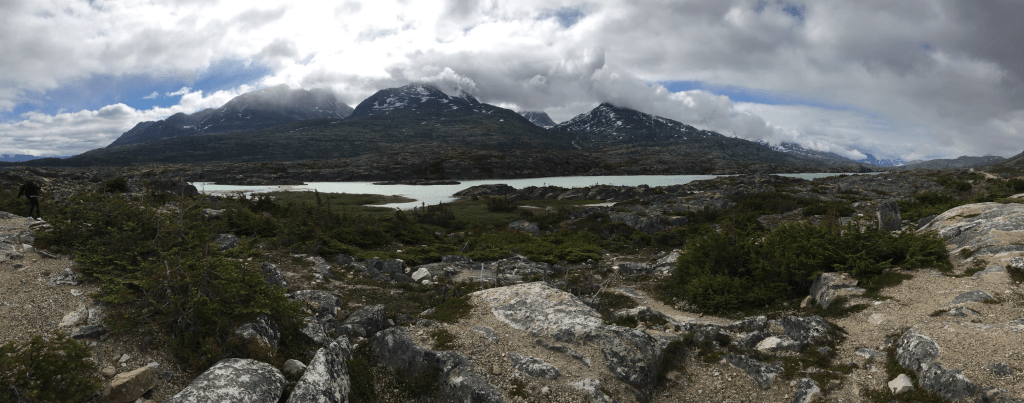
The bus took us to salmon bake buffet for lunch at Liarsville Gold Rush Trail Camp and ended at The Red Onion Saloon. I have no pictures of these.

The City of Skagway 
After Skagway, we had one last big adventure aboard the ship:

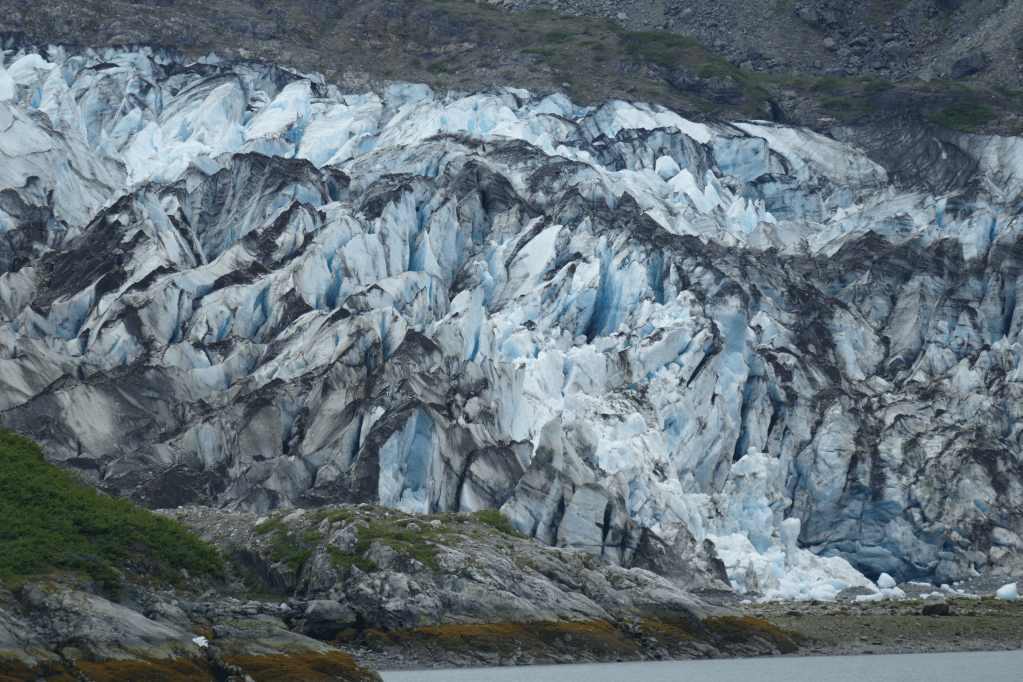
Cruising Glacier Bay National Park and Glacier Fjord
The Cruise ended in Whittier, where we disembarked. The fascinating thing about Whittier is that it was built as a secret facility during  World War II to support the war effort and provide a reliable trade route to the Alaskan Rail Road; the water here is ice-free all year making it an ideal area for a military base.

The Alaskan Land Tour Begins
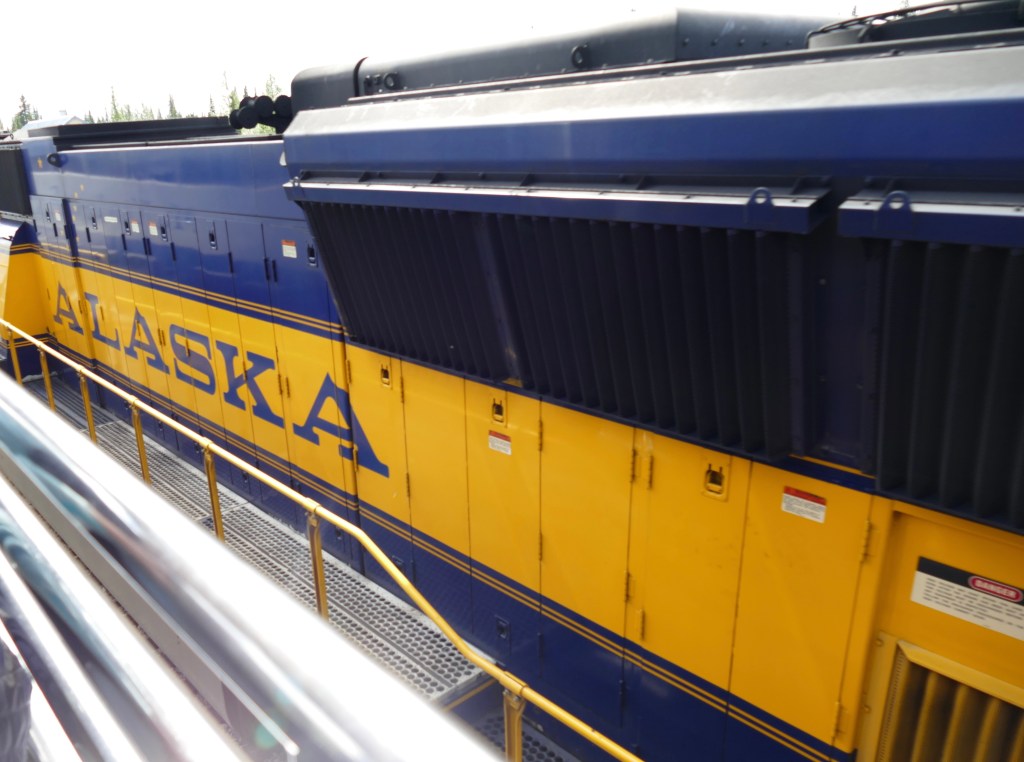
On The Train

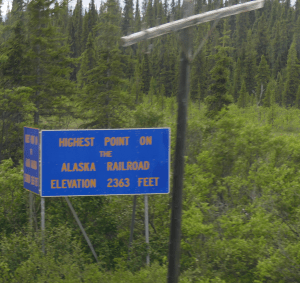
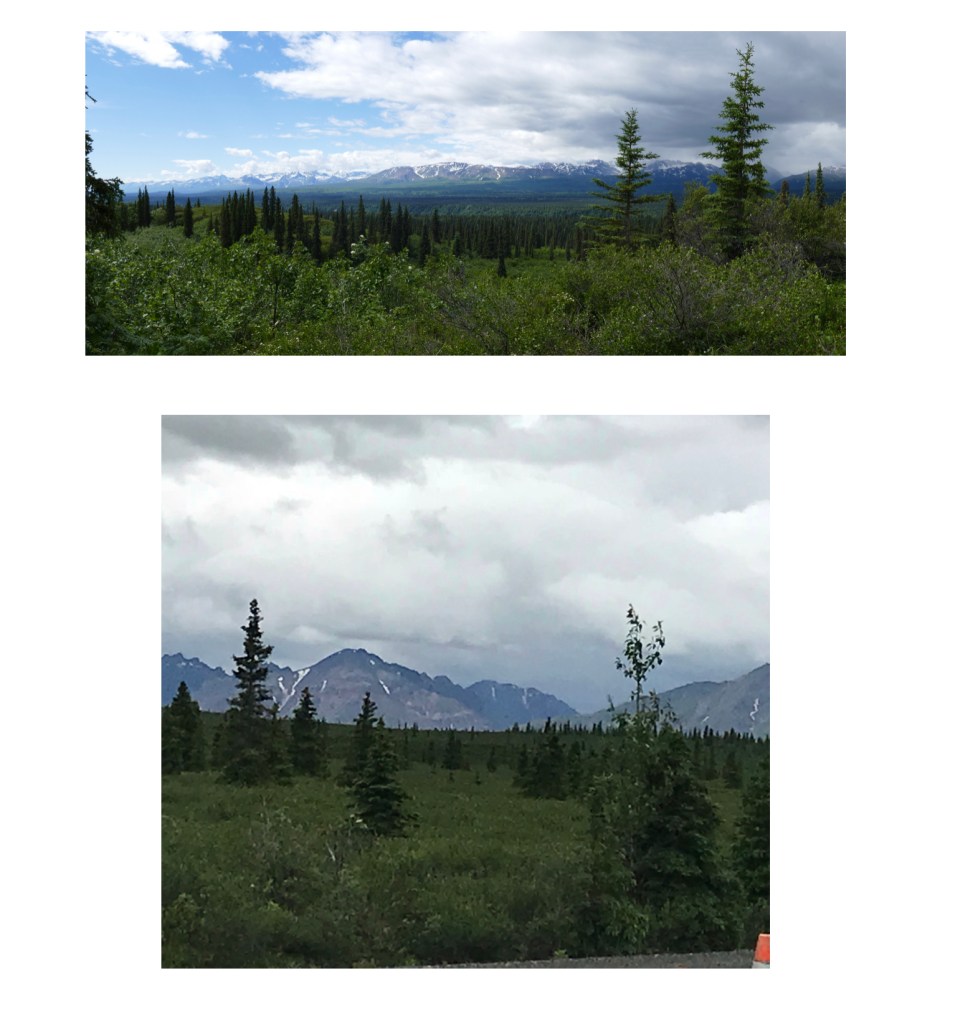
From Whittier, we boarded a train to Denali National Park. The trip on the train took about 10 hours, but we saw beautiful scenery along the way: 
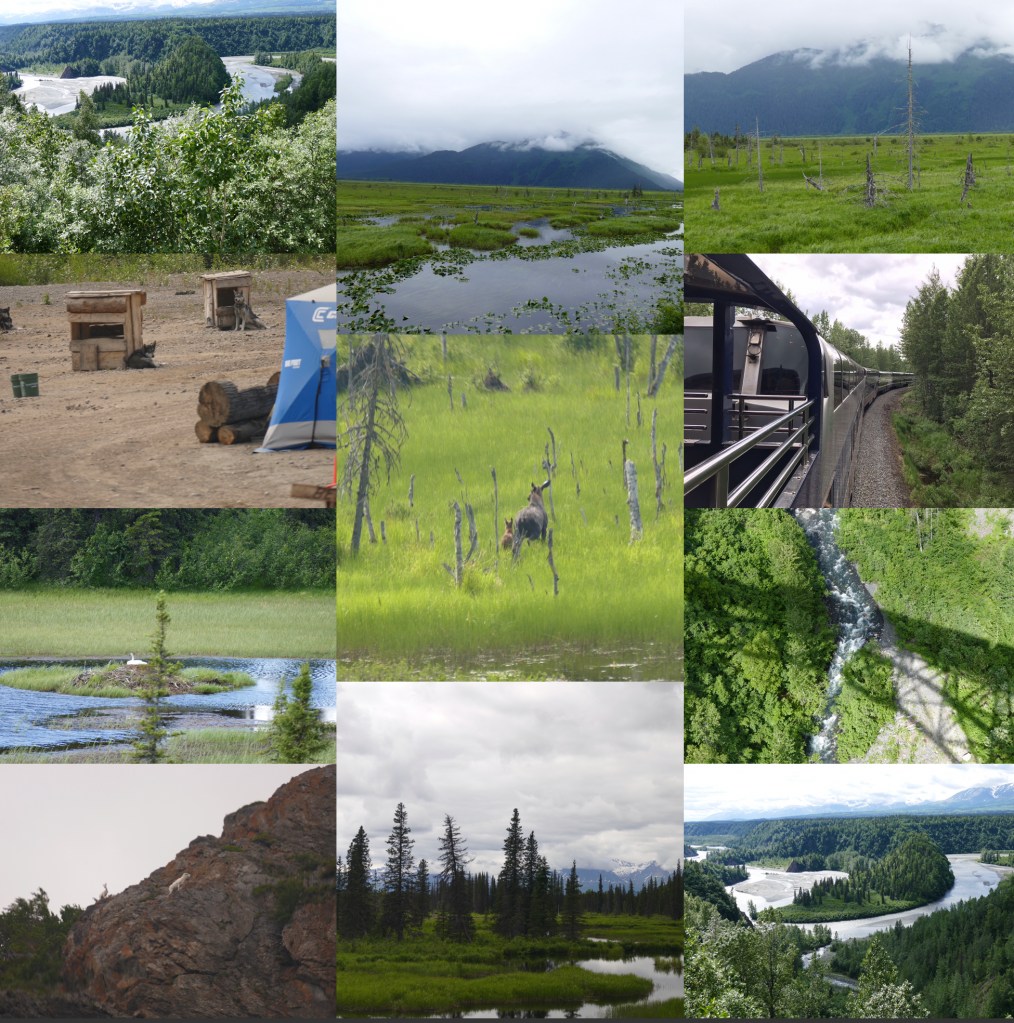
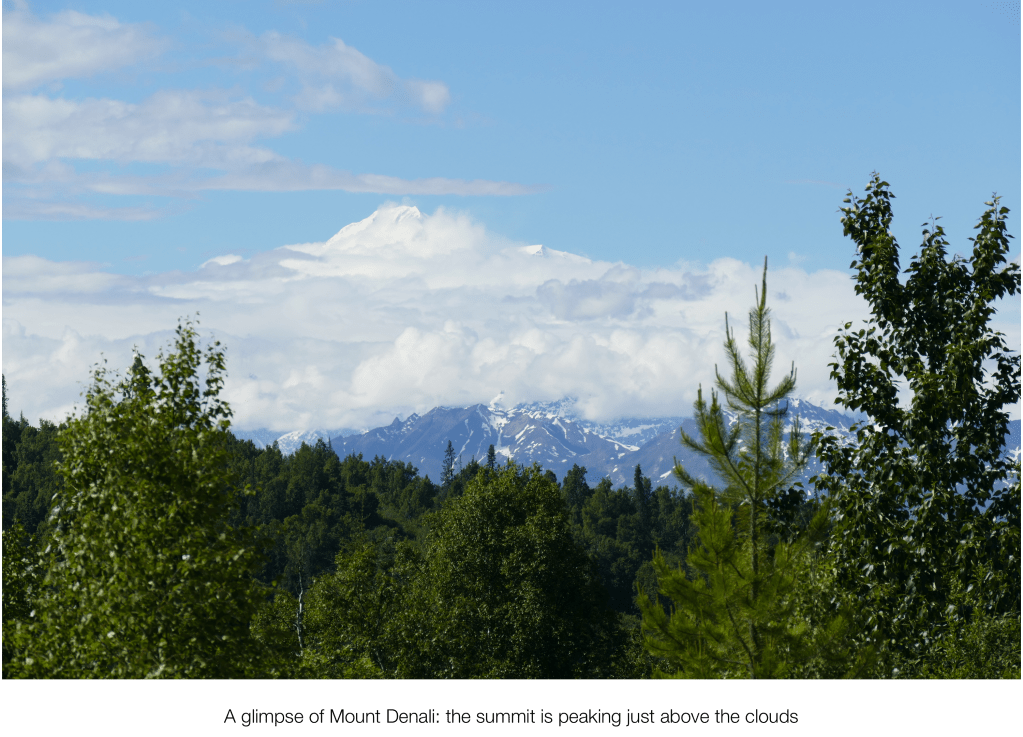
Denali National Park and Preserve 
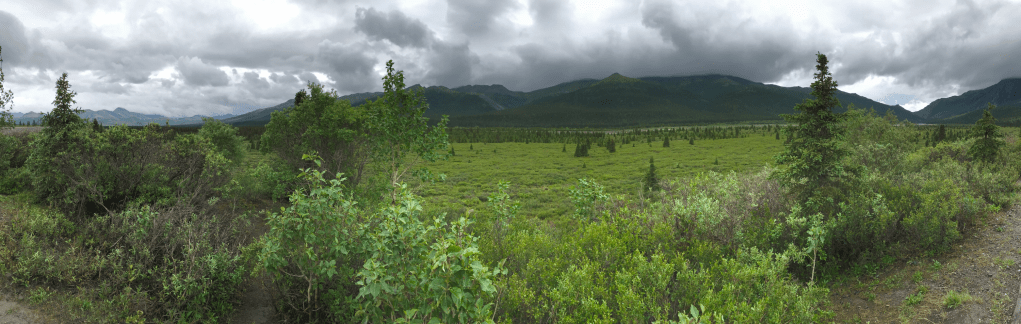
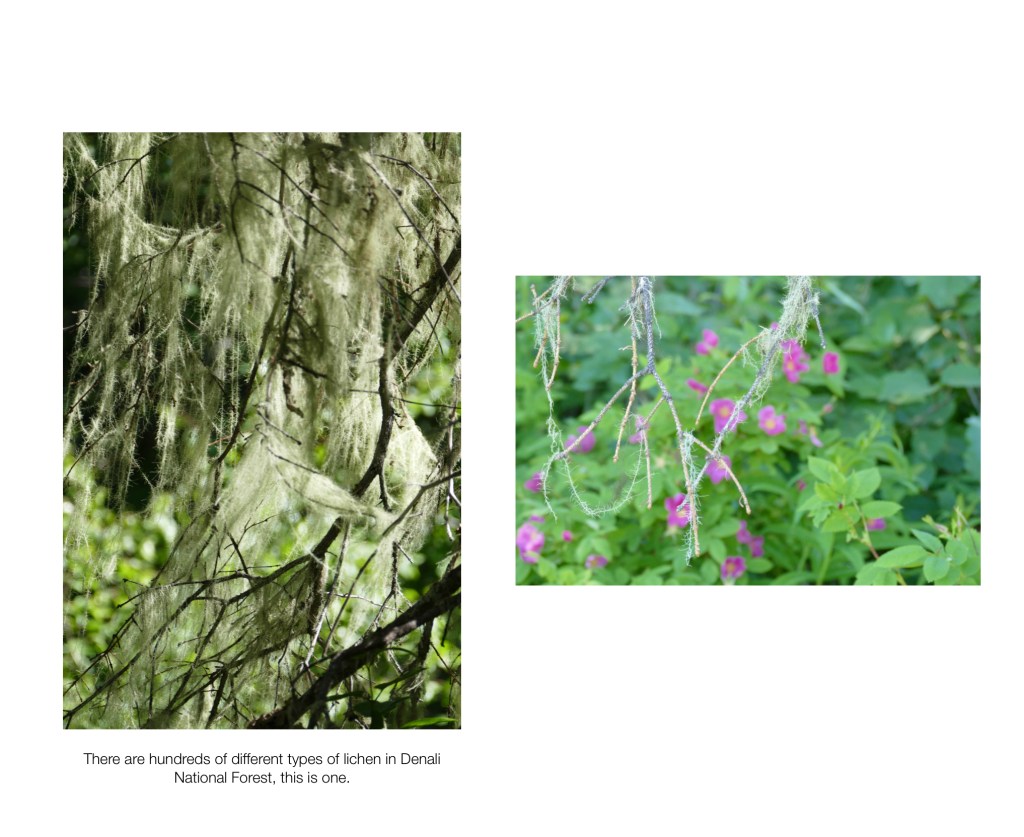
Mosses and Lichen

Moss and lichen grow in abundance in Denali National Forest.  Among other things, lichens provide a good food source for many animals and moss helps control soil erosion.

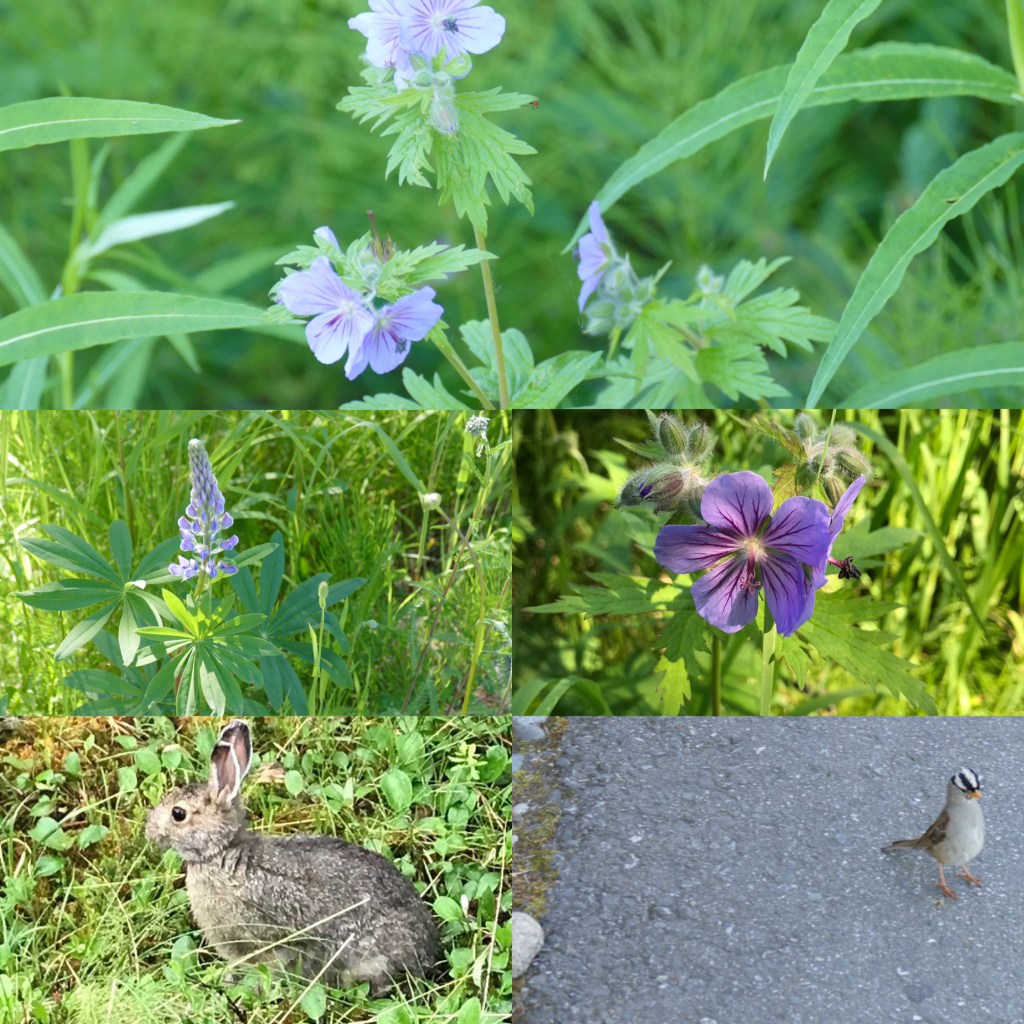
Some Of The Flora and Fauna in Denali National Forest
The official land tour ended in Anchorage, where an unofficial tour began
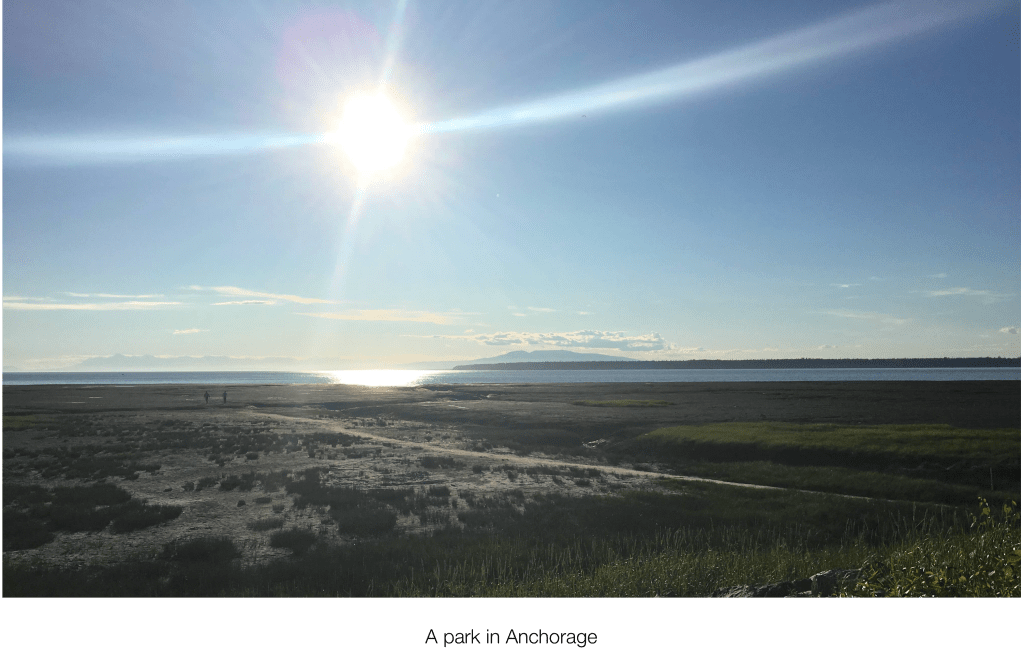
We spent a few days in Anchorage after our excursion with Princess Tours. Like most tourists in a city, we went to a museum, walked around, and ate at extremely good restaurants. 

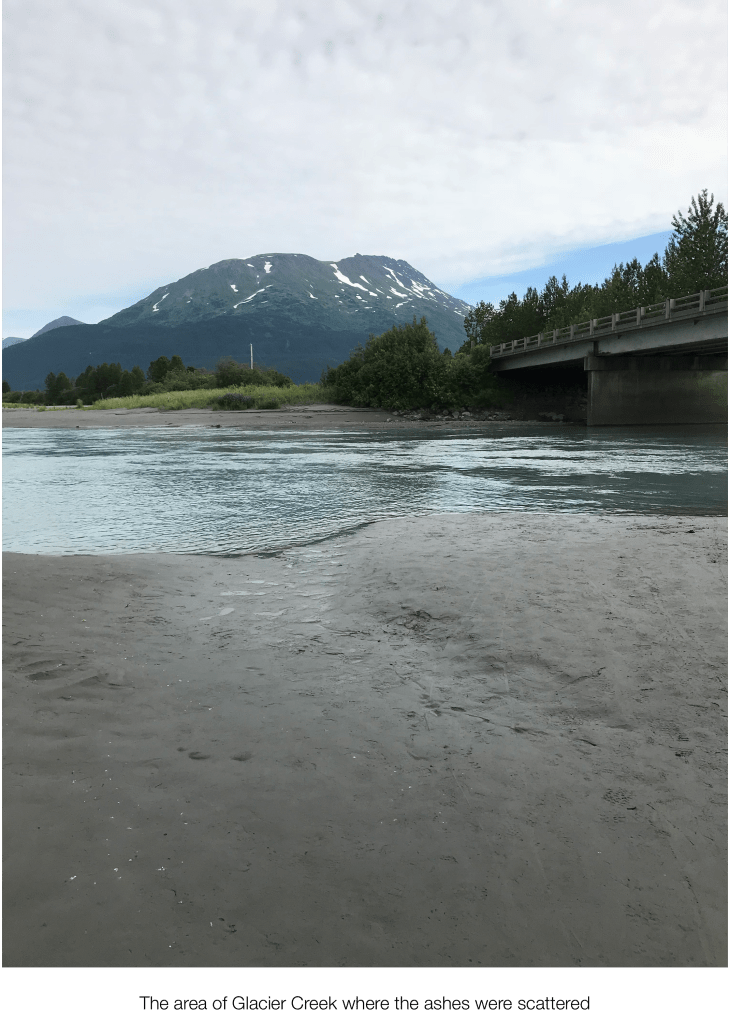
Unlike many visitors, we scattered my father’s ashes in an area south of the city called Girdwood. My father had been an anthropologist, whose work focused on the people and the land above Arctic circle.  We couldn’t make it up as far as the town called Kivalina that was so close to his heart.  A former colleague of my dad’s suggested scattering the ashes in Glacier Creek: we wouldn’t have to walk on mudflats that could be dangerous, but the water would eventually be taken out to the Pacific Ocean by way of the Gulf of Alaska. I had arranged for the remaining half of my fathers ashes to be sent to one of two Anchorage hotels where we stayed. The other portion of my father’s ashes had been scattered seven summers before on a lake in Ontario; the thought was to spread what remained of my father in the water of the two areas he loved most:  Muskoka, Ontario and Alaska.
At 10:00 in the morning, on July 4, 2108 we toasted to my dad. My three children, husband, mother and I sipped bourbon (his favorite drink) out of tiny bottles, while my mother’s partner looked on. 

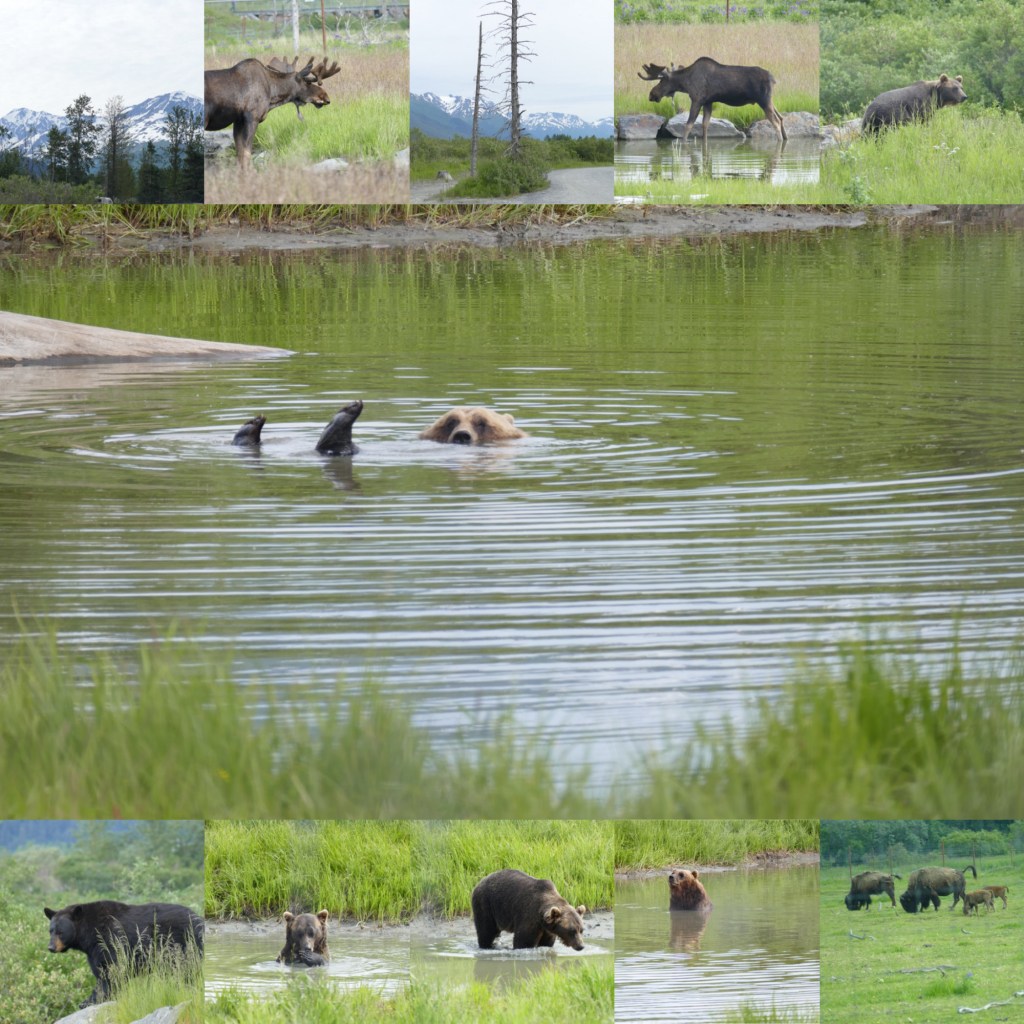
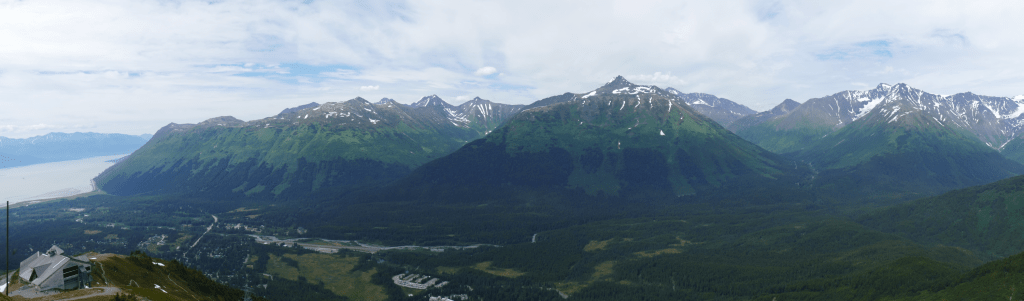
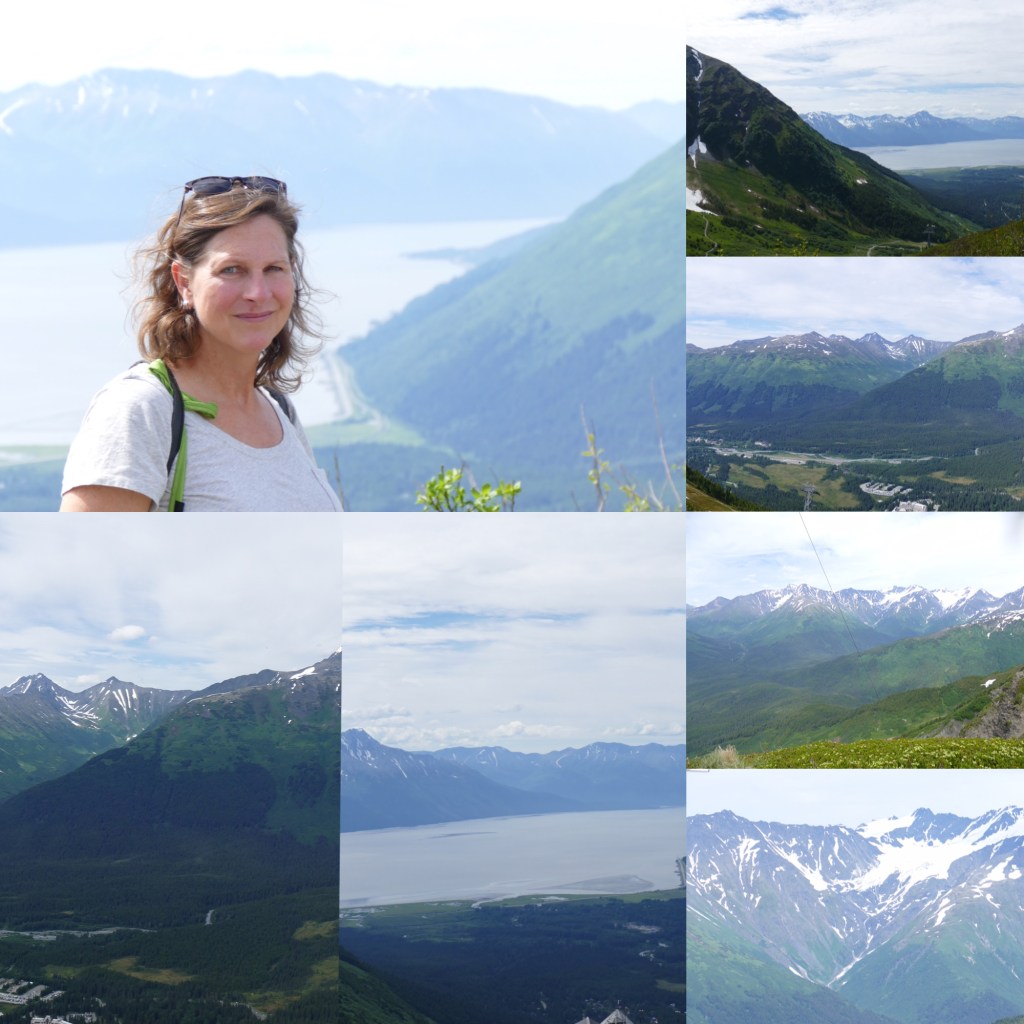
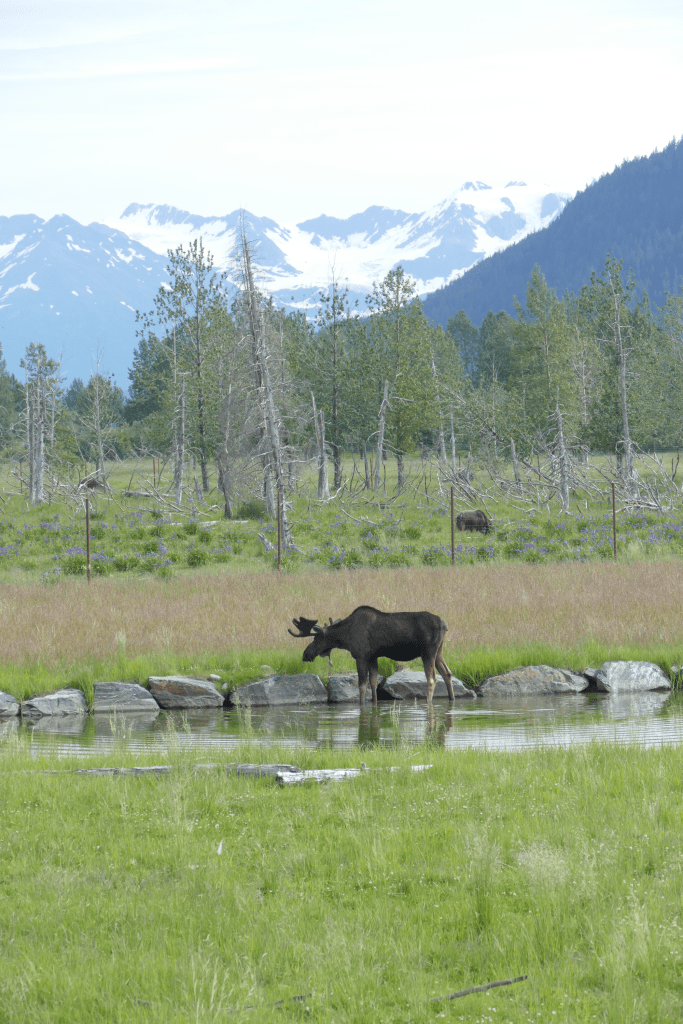
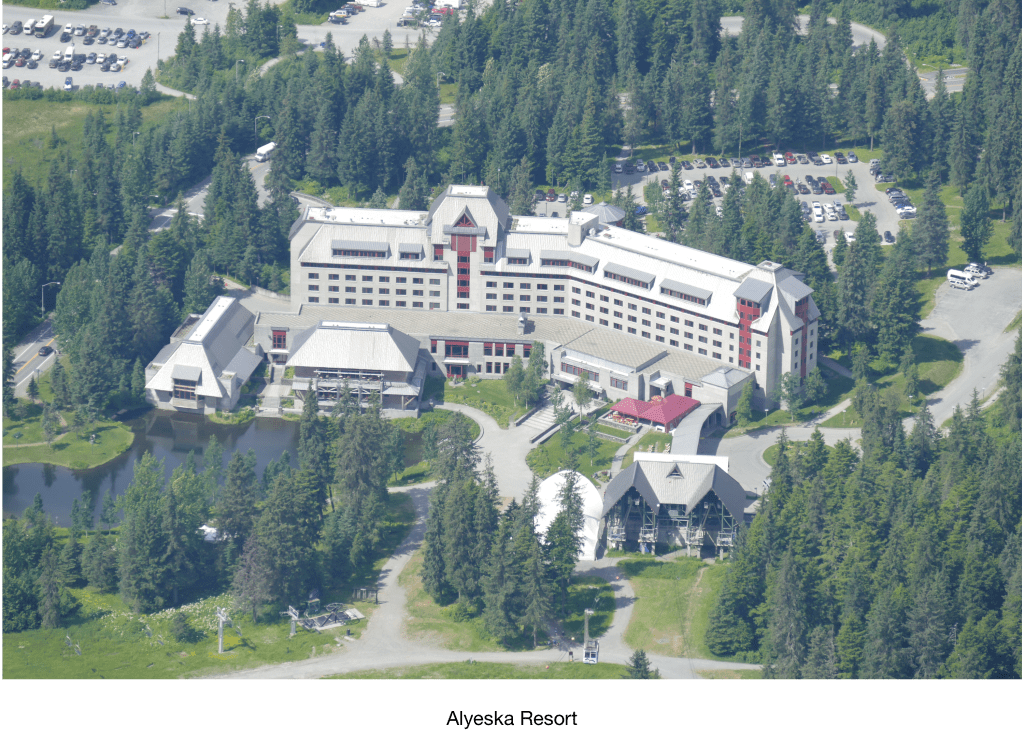
After the ashes were scattered, and we said our goodbyes, there were two more stops on that little road trip: Alaska Wildlife Conservation Center and Alyeska Resort.

Alaska Wildlife Conservation Center
The Views from above Alyeska Resort
Our Final Day In Alaska

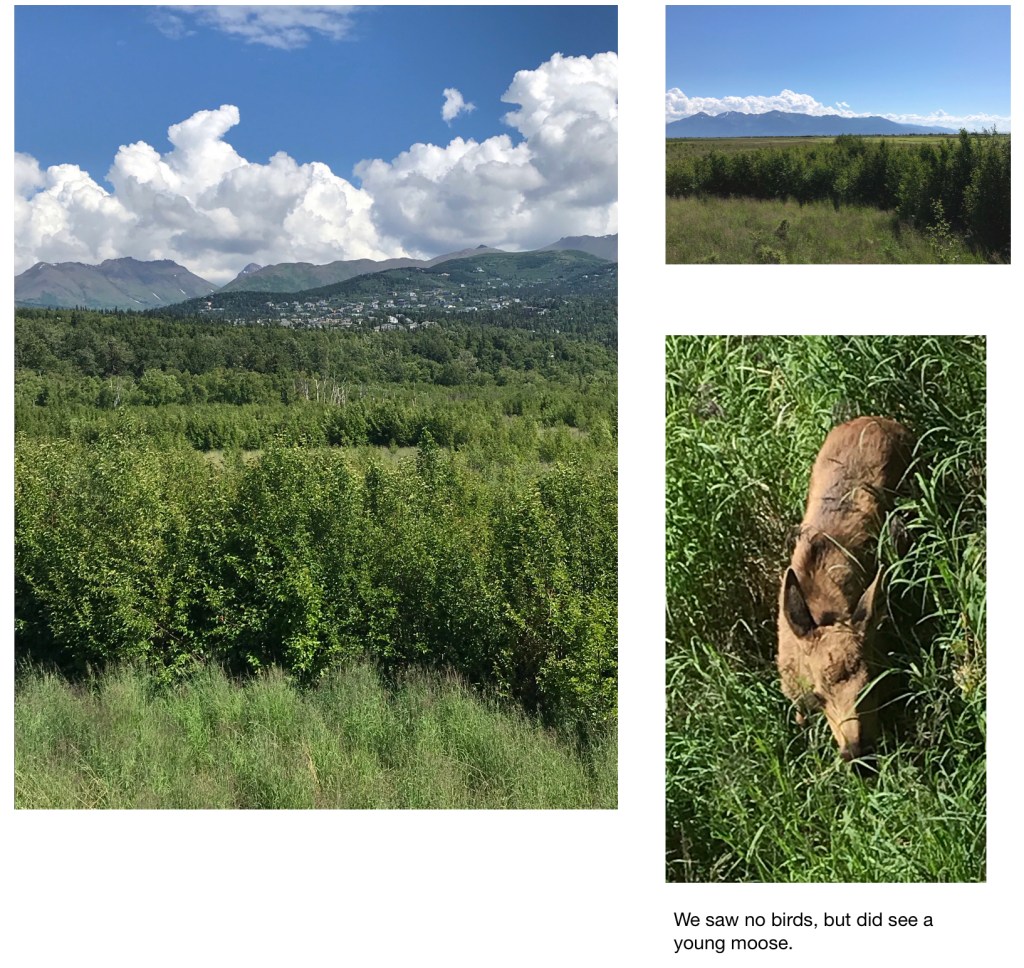
On our last day in Anchorage we had one final destination: Potter Marsh Bird Sanctuary.
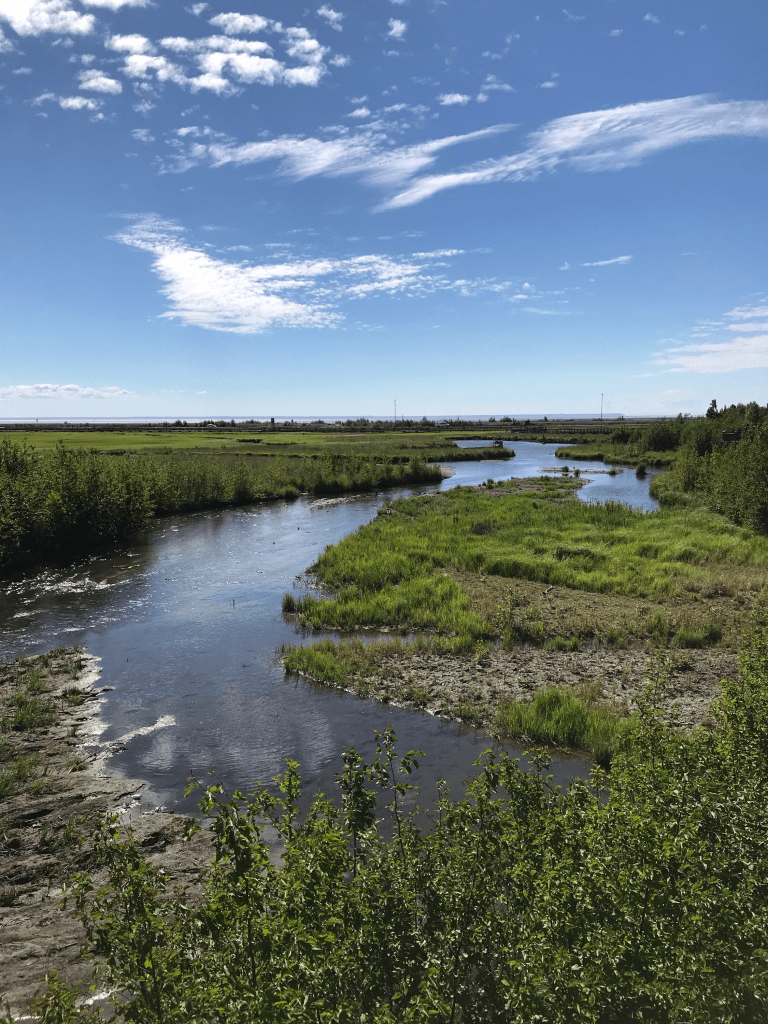
My mother took us on the trip of a life time! Truly this was the beginning of an ideal and beautiful summer. Unfortunately beauty can be fleeting. When we arrived in our summer home in Muskoka, about a week after our trip, our lives took us on a different kind of journey; one nobody could have expected…
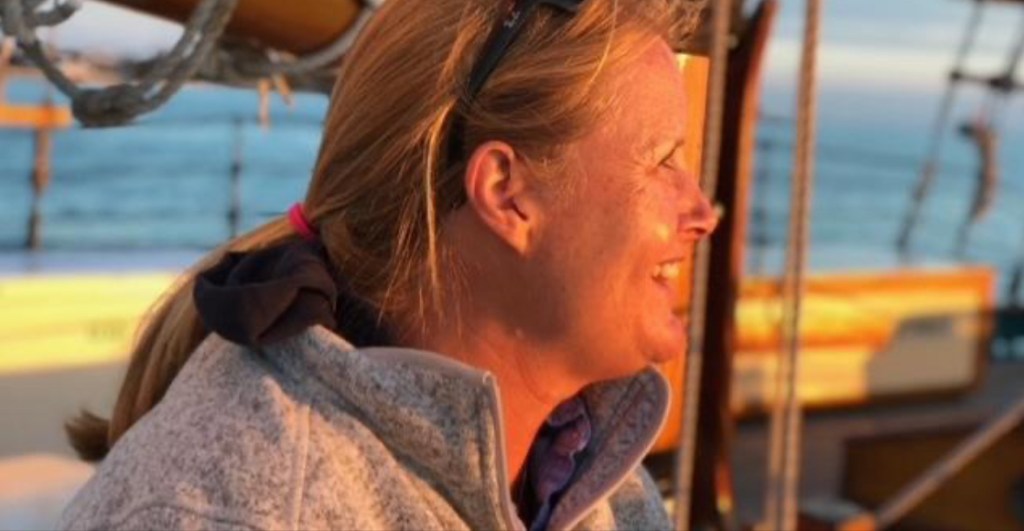
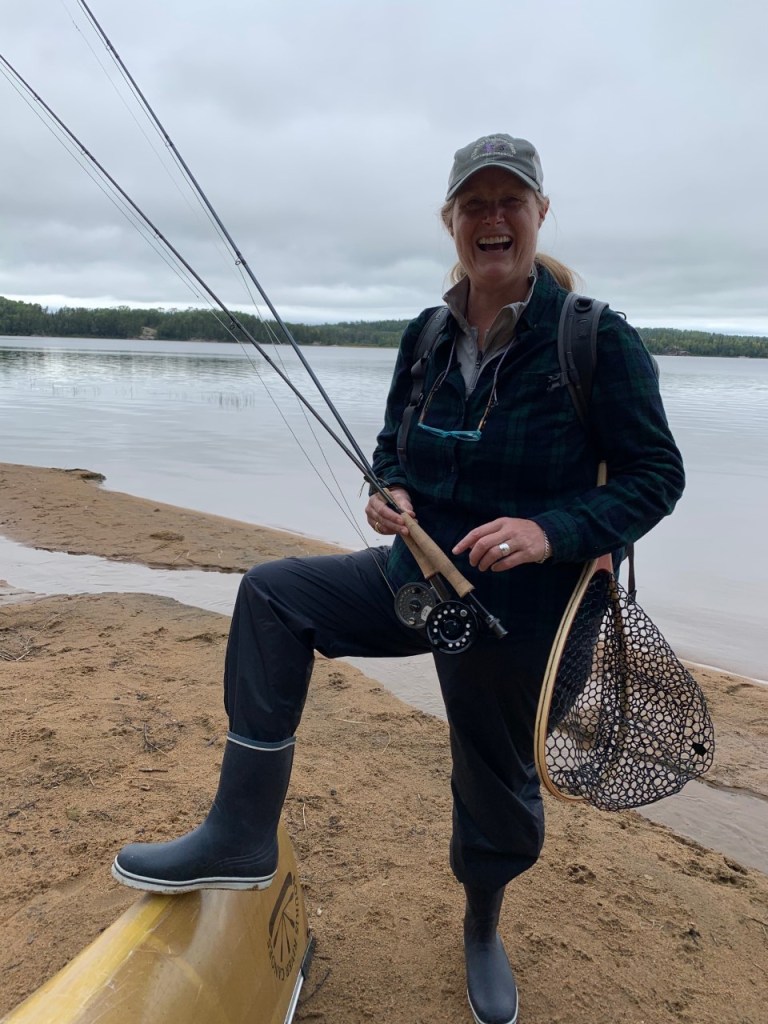
All Aboard! Self-Compassion and Acceptance with Heart Failure

By Heather Cartwright

My friend Heather wrote this beautiful and moving story about her heart condition called Arrhythmogenic Right Ventricular Cardiomyopathy (ARVC). The account of her journey living with heart failure was originally written and published on Our Heart Hub, https://ourhearthub.ca/. I contacted Heather and she was given permission for me to publish this on Tell Me Your Story.

I have lived over 30 years with Arrhythmogenic Right Ventricular Cardiomyopathy (ARVC), and for the past eight years I have lived with heart failure. ARVC is an inherited heart disease that can cause deadly arrhythmias leading to sudden cardiac arrest.
As the disease progresses, the heart muscle is replaced with fatty and fibrous tissue, causing it to weaken and pump inefficiently. In the worst cases of ARVC, heart transplant is needed.

I have learned that the best way to cope with the anxiety and uncertainty of living with this unpredictable cardiac condition is to treat myself with self-compassion, to accept the realities of my disease, and to live the best life I can.

My journey has taken many twists and turns. It’s like a train trip over rough terrain; down deep gullies, up to the highest peaks, around hair-raising turns, and over precarious bridges. Each section of the track offers its own challenges such as cardiac episodes, ER visits, ablations and device surgeries, PTSD after ICD shocks, and new diagnoses and treatments. Yet my train keeps chugging along, finding safety along the way in quiet stations. In those moments of calm, the views have been lovely and the company fine. I have met fellow passengers on this journey who have enhanced my trip, sharing inspirational stories of their own. I hope my story helps you. Come aboard.

The Beginning of the Journey

I was twenty years old when I collapsed with ventricular tachycardia following a rowing race. I was a collegiate varsity rower at Western University with aspirations of competing at the Olympics. I identified as a strong and skillful athlete, enjoying the thrill of outdoor pursuits like whitewater canoe tripping, cliff jumping, and ski racing. I used exercise for stress reduction, going on long runs to clear my head. In rowing I got the opportunity to push my body to its limits, enduring pain, and elation, at the outer edges of my potential. Suddenly, all that had to stop. When I was diagnosed with ARVC, I was told by my cardiologist that I could never do competitive or endurance sports again.

The particularity of ARVC is the unpredictability of deadly arrythmias. Some patients go years between events, and some may never experience a “hot phase” of recurring and random episodes of ventricular tachycardia, and even cardiac arrest. Whether influenced by stress, caffeine, physical exertion or other unknown factors, the heart can beat wildly and erratically, despite daily medications to keep it in line. The only way to save a patient during an event is to shock them with an ICD, inject them with anti-arrythmia drugs, or defibrillate them in the ER. Just like unplugging and plugging in a computer when it freezes, the reboot gets it back to normal. 

I was devastated. I was in denial of my diagnosis. In response, I often pushed myself and took unnecessary physical risks that landed me in the ER. 

Rough Terrain

During my twenties and thirties, I was angry and resentful at the limitations to exercise, diet, and day-to-day living I faced. I saw it as a betrayal of my body against the wishes of my mind. My dreams of the Olympics were over. I over-ate to numb my pain, lashed out at others, and retreated from intimate relationships in a misguided attempt to keep myself safe. I overworked in my career, trying for some fulfillment I could not find in my personal life. On the train journey of my life, I was in the lowest gully. 

But from the depths, I could see new mountains ahead. It was not my nature to wallow in self-pity, and it was clear that my rebellious self-harm was only hurting me. I decided that big changes were necessary in my lifestyle. So, I quit my corporate job to become a full-time rowing coach at elite US colleges. 

An Upward Climb

I loved coaching. Being on the water in nature, helping students reach their potential, and leading a group towards shared goals gave me purpose. Yet, even as my train was scaling higher peaks, I encountered scary hairpin turns – like the year my ICD delivered therapy 54 times. My type A+ personality had not diminished when I traded a corporate pantsuit for sweatshirts, a cubicle for a coach boat. My electrophysiologist encouraged me to slow down, but I simply changed schools to a more competitive rowing program. 

Finally, my hard charging personality of always pushing myself caught up with me; I collapsed on the dock during rowing practice and was rushed to the nearest hospital where they saved my life. Later, my doctor, with tears in his eyes, pleaded with me to quit coaching. He warned me that my next cardiac episode would be my last. The reality of my situation hit me: no matter what adjustments I make to my work schedule or environment, it was incumbent upon me to change my attitude to save myself. 

After quitting my coaching job and returning home to Toronto, I signed up for a week-long meditative retreat for mindfulness and self-compassion led by psychologist Dr. Christopher Germer and researcher Dr. Kristin Nuff. This retreat challenged every assumption I had about achievement and self-care. I had been brought up to believe that listening to that dark inner critic inside myself was necessary to my success. Initially, I pushed back at their encouragement to be gentle with myself, to forgive my body for its limitations, and to embrace my new reality. They advocated taking a pause and being mindful to provide a safe place for my body and mind to self-soothe and find relief. But it all seemed too soft to really work on a high achieving person like me. 

Yet, as resistant as I was to their practice, I decided to give it a try, even if only to show it would not work. To my surprise, it did. 

Over the years, I have attended many more retreats. I have learned to meditate by using phrases of self-compassion such as “May I be safe, may I be calm, may I live in peace.” I said these words with as much intention as possible. I tried to be open to whatever pain or unpleasantness came up and used these words to soothe myself. When sitting cross-legged on the meditation pillow, I resolved to make friends with my heart. I saw that it was not to blame, but to be forgiven. When words did not comfort me, I simply pressed my warm hands over my heart center. In time, I found myself less angry, more grateful, and more open to accepting the volatility of my condition. 

This new-mind set was helpful when my mother was diagnosed with stage 4 incurable lung cancer. As her primary caregiver, I was with her each day and at all her doctor’s appointments, chemo treatments, and operations. We shared more than just a familiarity of the ins and outs of the hospitals along Toronto’s University Avenue: I had been living with the threat of sudden cardiac death to my mortality since I was 20; my mum was now confronted with the end of her life at age 78. Together, we shared our understanding of the impermanence of life, that nothing is for certain, and that accepting one’s reality of “what is” instead of “what one hopes for” is the most grounded way to cope. We had deep conversations about life and death, and where one goes after they die. We did not have answers for our questions or assuage all of our grief, but just talking about the taboo subject of death lessened our anxiety. My mother died a peaceful death, surrounded by loved ones, comforted by the fact that everyone was fine and it was her time to go. It was a profound experience. 

Unchartered Territory

Just four months after my mom’s death in 2014, I was diagnosed with heart failure. The train was now crossing over a bridge to an unknown land. But I felt confident that I could handle what came next because of my attitude shift. I was learning to love myself and to practice self-compassion in the darkest times. I was accepting my heart condition as it was. And I was no longer so occupied with my fear of death, but instead on living my fullest life. That shift encouraged me to embrace what I could do; to appreciate my friends, family, and loved ones with gratitude; and to live in the moment. 

In short, I have negotiated a peace with my limitations, with death, and with living with ARVC and heart failure. “Negotiated,” because it’s an ongoing process to love myself and accept my condition when setbacks occur. 

One aspect that has been helpful is to know my body. With heightened awareness of my heart rhythms and body feelings, I have an acute sense of when something is “off,” relative to times when I felt better. This gut feeling is so critical. When I feel “off,” I know how to begin again – with self-compassion meditation, healthy food, time in nature, and, most importantly, rest. That way I can enjoy the activities I love, like walking my dog, golfing, fishing, and kayaking. And if things don’t go back to how they once were, I have the mindset to try to accept my “new normal” with loving compassion. 

The Journey Continues

My journey with ARVC and heart failure has been a long one, but I am not alone. On my train I have the best drivers and engineers: the doctors and medical team at the Peter Munk Cardiac Centre always find the smoothest, and safest, routes for me to take. Working in partnership with them, I know I have the support to go the distance. 

And to enjoy the journey along the way, I have filled the passenger cars with my partner Karin, my friends, and my family. No matter the destination, I am determined we will appreciate the trip together. I will do what I can do, for as long as I can do it, for now. 

It’s been one heck of a trip so far.

Run No More

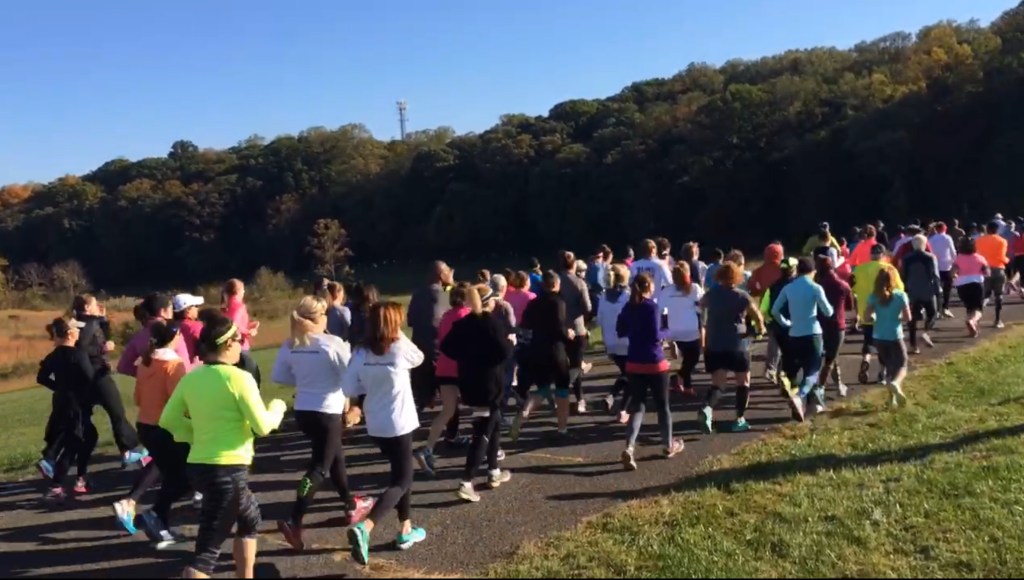
A Running Event at Winterthur

“Will I be able to run anymore?”, I asked the orthopedic surgeon.  He gave me a look and said, “What do you think?”.  I had just been informed that I had (still have) severe arthritis behind each knee cap. Just another ending, I thought.  Another thing to mourn.  I ran for 33 years. I  was not old, just 51, but I knew for years it was just a matter of time before my knees could take so much

Growing up, I was aware that my father ran almost every day.  He typically went out mid day, so I only saw him go out for a jog when I was home.  I was born a swimmer.  Eventually I followed my fathers lead and began to run. I started in college. On my first or second  day of my freshman year in college I was asked if I ran. I said, “No, but I probably could”.  We formed a running group.  A few days a week we would all run together.  Thus, began my love of running.

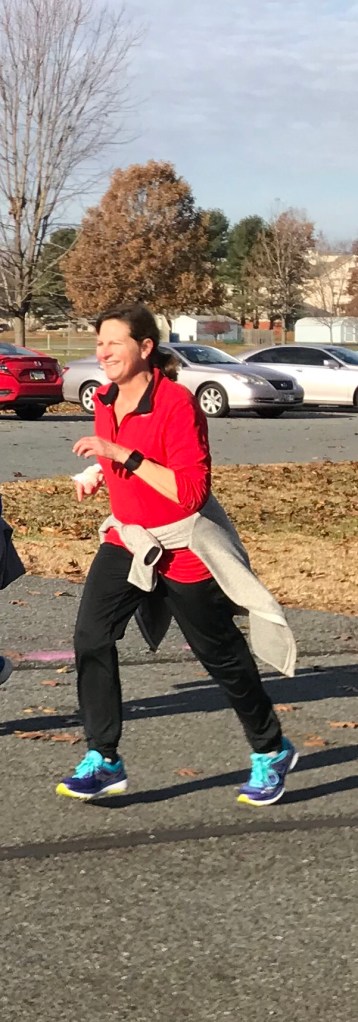
Me, running with my youngest daughter (not pictured) in Girls on the Run, December 2017. I had not been running for two months due to tearing my ulnar collateral ligament in early October.

Over the years I was in many races: sprint  triathlons, 5ks,  10ks, half marathons….

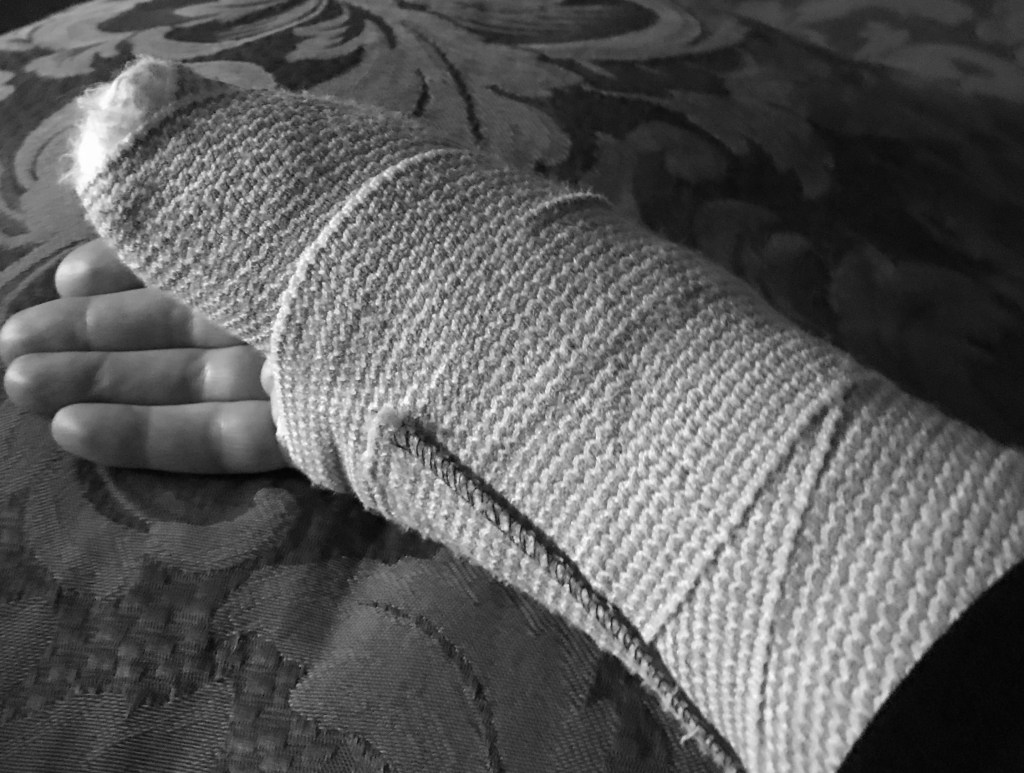
The run, in the picture to the left, was a month post surgery. If you look closely at my right hand you can see that I am still wearing this wrap.

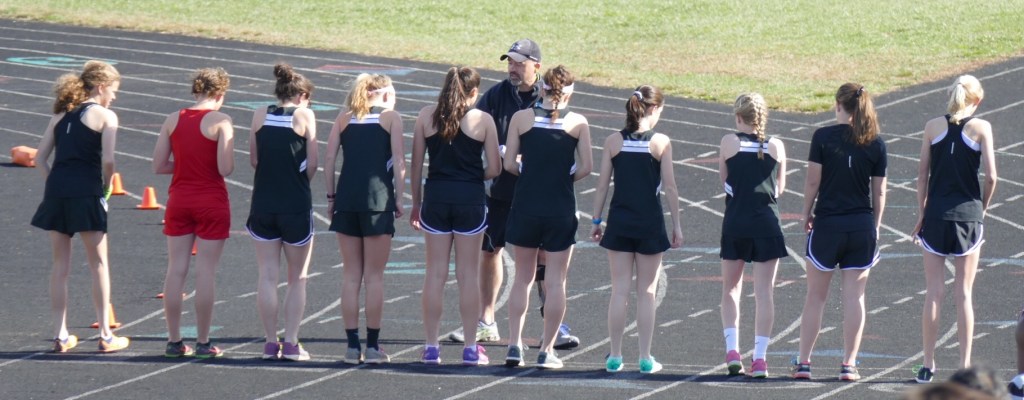
When my eldest child was in high school, I had the pleasure of watching her run cross-country and track.  As I watched other runners, I came to realize that some people are born runners and some are self-made runners. The born runners seemed  to have perfect form, a long stride and run with little effort. The self made runners were those people who have taken up running not  because they were born to run, but because they wanted to run. I was a self-made runner.

My favorite photo from my daughter’s first year running track.


As I approached my 30th year of running, I began to question why I called myself a runner.  I did not have great form and I always ran middle of the pack when I raced. Once, I read something about how you know you are a runner.  Many of the things it said hit home, but this line summed it up for me: ” your are just not yourself when you don’t run”.  

Running  became a part of who I was. I was proud when someone said “you look like a runner”. People asked why I ran.  “It puts so much stress on your body”, they’d say.  Everyone knows that running puts stress on your joints. But running is so much more than that.   It helped me to think. It helped me to sleep soundly. It helped me to see the world around me.  I could lace up my shoes and run out the front door.  Most importantly, running helped me get through many of my darkest times: the times that I felt I could not breathe, running helped me to breathe again

2018 dawned bright with promise. My eldest was accepted at the college of her dreams. My mom took us on a cruise to Alaska to celebrate  my daughter turning 18, her graduation and my 50th birthday. I was training for my first half marathon in several years. When we arrived back from Alaska and were settling in for a relaxing summer, our world came tumbling down. Still I ran.

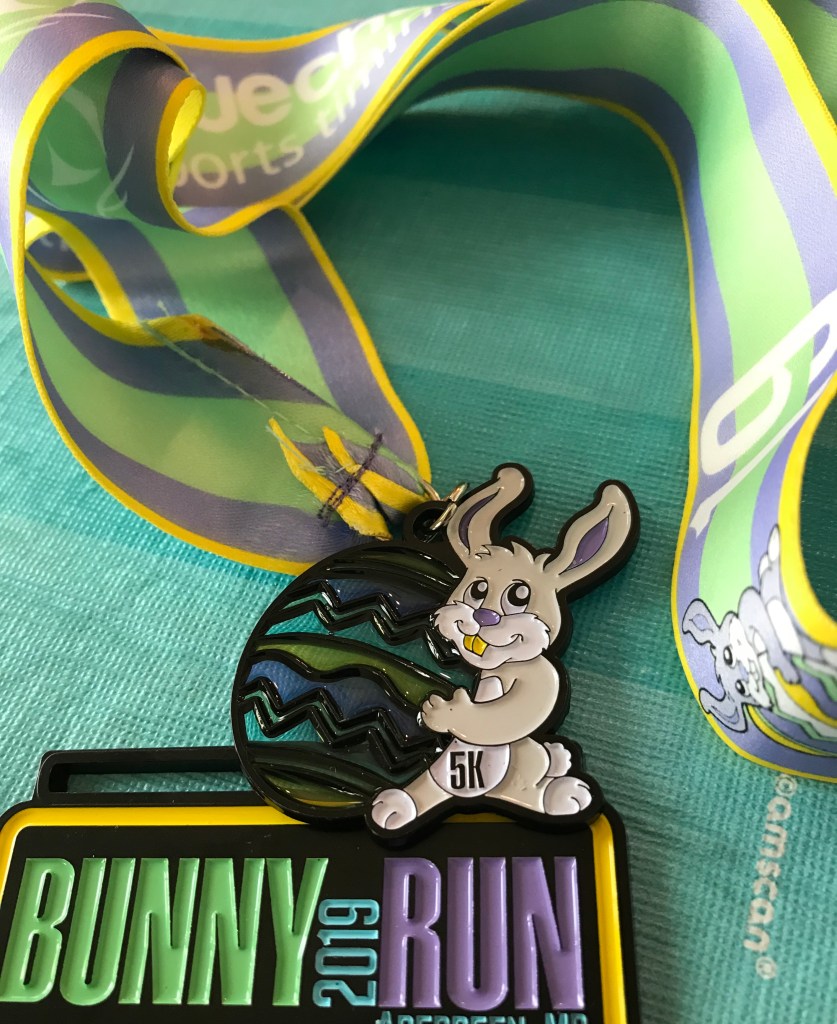
Participation medal from a 5k i went in with my youngest child.

I ran through fall and winter with a heart so heavy I felt like I would implode. I practiced yoga several days a week and used that space to cry on my mat. I ran another half marathon in the spring of 2019, little did I know it would be my last. My running was slower, often I would walk up the hills. My knees did not hurt too much. On I ran.  

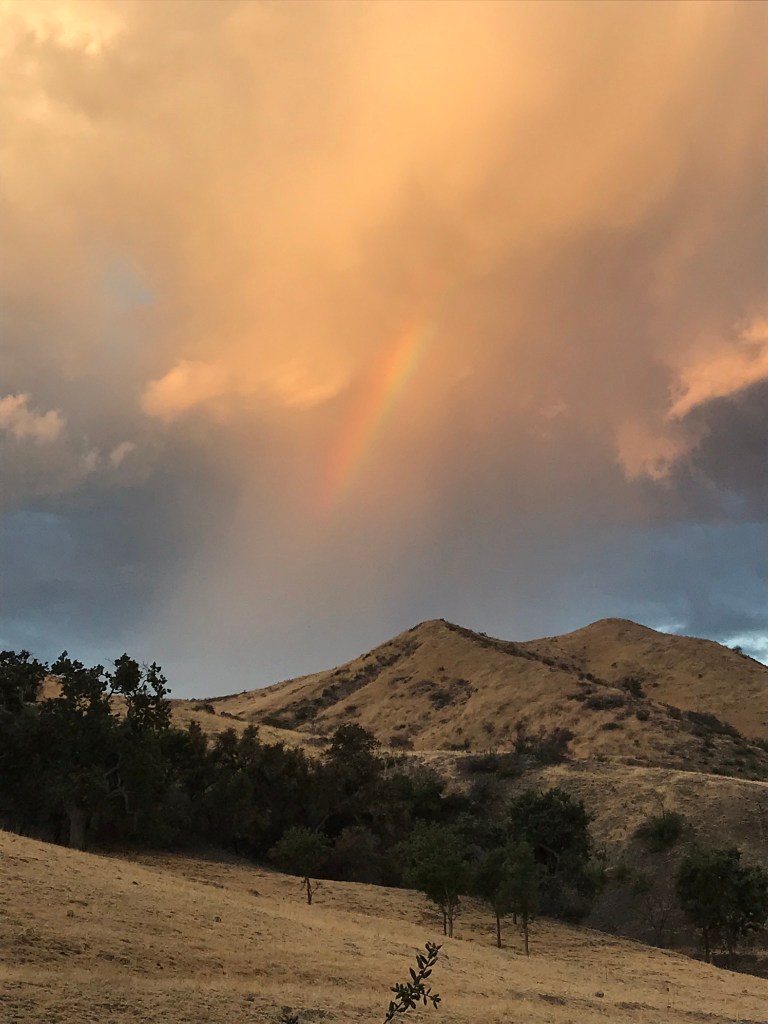
A year had passed after our life caved in. We were in full crises mode. In the summer of 2019, I ran next to the jasmine scented hills of  California. 

Running at dawn in Agora Hills, CA


I  jogged through the wood laden roads of Muskoka Ontario. 

Muskoka Ontario


That summer, in Ontario, I taught myself how to water run properly. I still cried on my yoga mat.  By then, my knees were making an audible sound; when I went into warrior II pose, those practicing yoga beside me could also hear my knees rubbing together.

The fall came. I had been slowly working through the pain in my soul. By October my knees were hurting, so I took a break from running.  Visiting my daughter in Boston that month, I had plans to do some elaborate walks while she was in class. My first day there, after having breakfast with my eldest, I intended to go on a five mile walk.  I started out walking, through neighborhoods I did not know, when my knee went out. All I could do was drop to the sidewalk.  I did not run.

I was not able to run to an old age like I wanted. Maybe when I when I became emotionally at peace with everything that was going on in my present, as well as the trauma of my past,  I no longer needed my knees to carry me. My running shoes have turned into walking shoes. I go to a pool almost every day. I swim and I run the only way I can: in the water.


MARCH 2021 /March2022

 Deanne Burch  Alaska  February 27, 2022 8 Minutes

When I started writing this story, I could not have envisioned the tragedy that is happening in the Ukraine right now.  I was feeling bright with hope. The world was beginning to open up after almost two years of people being isolated from each other. Have we learned nothing as humans, after two years of semi-isolation, about how to treat our neighbors with dignity and respect?  I think not and this is very sad! As I go to publish my blog and muse on what last March brought for me, I wonder what this March has to bring for the world…..

View from my deck 2021

 A year ago, my birthday coincided with the publication of my memoir: Journey Through Fire and Ice*. Covid gave me the opportunity to launch my book. However, the virus extinguished the celebration of my significant birthday. Starting last March, many of us were slowly able to be vaccinated against Covid, hoping to regain some normalcy to our lives; to some of us it meant being able to travel again. For me, the vaccine, simply meant I could see some family. My older daughter and grandson flew in from California in July. During her visit, Trudeau announced that on August 9, all vaccinated people could cross the Canadian border.  My younger daughter, youngest granddaughter and I went to Canada in mid-August for three glorious weeks. It was a joy  to be up there! I was overwhelmed when my two brothers and their wives graciously hosted a delayed “Big Birthday” and happy to celebrate with family and old friends. 

March of 2022 marks the one year anniversary of my book. For me, writing this memoir, was a journey that was several years in the making. I started writing it after my husband died, not sure if I would ever publish it or even if I wanted to. When the book was finished, I knew I wanted  to publish it. I felt women should learn they could deal with a life that was very different than the life they were brought up in. My life in Alaska would show others an example of how to adapt to the triumphs and tragedies that happen along the journey called life.

Holding my copy of memoir

Publishing was more difficult than I expected. I had sent the memoir out to a few agents with little response. About two years ago, my brother called and said “Deanne, life is short, you really need to get this published”. In the end, I took the self-publishing route, hiring Authority Publishing, a non-fiction company to publish the book for me. They helped me all the way through the publishing process. On March 1, 2021, I had a copy of my book in my hands. It was an exhilarating moment! Of course marketing a book is never easy…I had a social media expert, Cheryl Callaghan, help me as well as a PR agency. This has led to radio interviews and podcasts which were interesting for me, and I hope for others as well. 

Woman on right is one I correspond with.
She is now in her seventies
Kivalina as it was in 1964
parka made for me by one of Facebook Friends:Sonja Barger

Since writing the book, many of  the Inupiaqs who live in Kivalina have been in touch with me and are friends of mine on Facebook. This has been the greatest benefit of all. I often wondered what happened to  the people I knew and loved when I lived there. Most of them are deceased but their children and grandchildren are still living in Kivalina. I live their life through their posts and photos on Facebook. When we lived there the population was 150 people and it has exploded now to 450. However climate change is forcing this village to move upriver. By 2025, the island of Kivalina will be underwater.

For those of you who have not read Journey Through Fire and Ice, it takes place in 1964-1965 and is a short period in my life. Kivalina is a place  where I learned that life is not a fairy tale. At the time, I had to live with a different culture, in a village with no plumbing, electricity or running water. My life, on a small island 83 miles above the Arctic Circle,  was different than anything I could have ever dreamt of:  a white city girl cutting up seals, living under the midnight sun and suffering through the minus 30 below weather when darkness set in. I became the woman I am today because of the triumphs and tragedies during my life there. If you haven’t read my memoir, come and take the journey with me and you will understand why Kivalina will live in my heart forever. This memoir is only part of my story. 

Writing  this blog, I never intended to end this as wish for peace. Today all eyes are on Russia and Putin’s takeover of the Ukraine. I wonder how our country can just stand by and do little to help this proud country. The sunflower, a flower full of happiness is the national flower of the

National Flower of Ukraine

Ukraine. For those of us who are on Facebook, please post photos of sunflowers in support of and prayers for this country. They never asked for this war and don’t deserve the horrible act of aggression that is taking place now. 

* Authors Note: This coming  month, to celebrate the one year anniversary of publication, the kindle version of the  memoir will be selling on Amazon for $4.99 instead of the regular $9.99 so if you have friends who  havent read it or if you havent read it, I hope you will consider buying it. I have been happy with the reviews and have been surprised to find that although I thought my market was primarily women, men enjoyed it as well. Reviews are very important and I appreciate all of you who have taken the time to write a review for me.

My Daughter’s Choices: A Mother’s Perspective

By Deanne Burch

Me with my daughter, Sarah

It is the  beginning of August, 1983 and I am sitting on the dock watching my fifteen year old daughter swimming. Sarah has always been my water baby, learning to swim at the age of two, and starting to compete at the age of six. She was always last off the block but seemed to catch up and win each race that she went in. Today, as I watch her, I realize that her days of competition have come to an end and tears come to my eyes as I know what lies ahead of her.

Earlier this year she was diagnosed with a severe curvature of the spine. She had the choice of wearing a brace for four years and at the end of this time she may or may not need an operation. In addition to this, the doctors told us that she would probably need counseling  because she would probably hate her body during this time. The brace would be uncomfortable and she would be limited  in her activities. The other alternative was to have an operation to straighten the curve. It would involve putting a rod in her spine to straighten it.

Sarah at age 14

She was only fourteen and yet my husband and I let her decide what she wanted to do. She chose the operation knowing the side effects that could possibly happen.

As I watch Sarah, she is doing duck dives and ballet legs and I wonder “will she ever be able to do these things again.” I know there is a possibility that she might die during surgery. I nearly lost her once. I know I could not bear to lose her because of the choice she made. Will she end up as a paraplegic? That might happen as well. Now the tears are running down my cheeks and I wonder if this decision is right for her.

August 17th, she is taken into surgery; it is the longest day that Tiger and I have ever spent, waiting to find out if she will be okay and if the operation has been a success. Neither of us has talked at all to each other, too afraid of what might lie ahead. We sit silently until the doctor comes . Seeing him smiling, we know the operation was a success. Sarah will have many days of pain ahead of her and she will have to be in a brace for several months;  all that seems insignificant now, because her future looks brighter than before. 

                                                                            ****

It is now late August, 1988. I am sitting at the Harrisburg airport with Sarah and my mother- in- law. Sarah is going to London to spend a semester with the Syracuse University program abroad. I am excited for her. Tiger and I are planning on going to see her sometime this fall and she promises that she’ll be home after Christmas, before the start of second semester. She’ll have so many stories to tell us then and I can’t imagine Christmas without her. Going home, I feel the silence in the house. David is God knows where and Karen is in Boston. Tiger is traveling. All I have are the dogs. Christmas is only three months away and the house will be filled with laughter and joy. Three months is not a long time to wait to have most of the family together again.

Sarah has been gone now for a month and I get a letter saying how much she loves it there.  With our permission, she has decided to stay for another semester. I am not happy with this turn of events but we gave her roots to grow and wings to fly. She is surely going to fly when she is in London.

Now it is December 21, the longest night of the year. Karen will be home tonight and Tiger and I are sipping a glass of wine when the phone rings. It’s my friend, Anne telling me there has been a plane crash over Lockerbie Scotland and there are no survivors. I wonder for a minute why she is telling me this when she suddenly says “Many of the passengers on board were from the Syracuse program abroad.”

Sarah is safe. I know she is….or is she? I start to worry. What if she decided not to travel and to come home to surprise us? I can’t get this thought out of my mind. By the time we pick up Karen from the airport, I am consumed with fear. The first words out of my mouth are “Was Sarah on that plane.?“ I knew Sarah would tell Karen if she was going to surprise us.

Karen didn’t know the answer. Suddenly I can’t believe that I didn’t greet her with a hug and kiss. After all she is my daughter too and I am overjoyed to see her.

We spend the night hoping, praying that Sarah is safe and not knowing.  I toss and turn all night. It is the morning of December 22. The phone rings and I’m afraid to pick it up. Sarah is on the phone, calling from a distant phone booth someplace in Europe. We both start to cry knowing that had she not decided to travel over the holidays, she would have been on the plane that exploded. That was the flight that carried the students she had traveled with on her way  to London.  I thanked God that she was safe because of the choice she had made.

Snapshot of Sarah in London

Sometimes I wonder if Sarah had a guardian angel watching over her. The choices she made changed her life forever and I am so grateful that the decisions she made were the right ones for her. 

My Choice

“Mom, how did you improve your posture?”, my eldest daughter asked me last week.  I looked at her and  smiled, questioning, “Did I improve my posture?”.  She said, “I don’t know, but I know you have tried over the years; improving my posture is my New year’s resolution.”  “Oh,” I said, slightly chuckling to myself.   For over 38 years I have been trying to improve my rounded shoulders, a bad habit, that I may have started because of a choice I made.

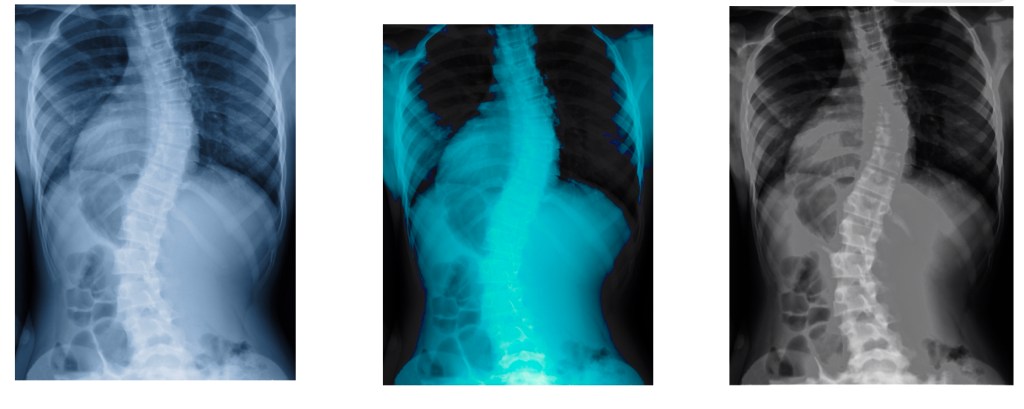
When I was eleven, my pediatrician discovered I had scoliosis; this is a medical condition in which a person’s spine curves sideways.  Often people with scoliosis are put in a back brace. My parents took me to an orthopedic surgeon who did not feel that the curve in my spine was significant enough for me to wear a brace. Over the next three years I went to a few different doctors about my scoliosis. By February of 1983, when I was 3 months shy of my 15th birthday, I was told I would definitely have to wear a back brace and possibly have an operation.

The last doctor we went to, Dr. Harrison, recommended two methods for straightening my spine. The method he felt would be most effective was a spinal fusion; a stainless steel rod would be placed along my spine and fuse my spine in a straighter position. If I chose the spinal fusion with the Harrington rod, I would be in the hospital for ten days, wear a back brace for three months, and be out of all sports for six to ten months.

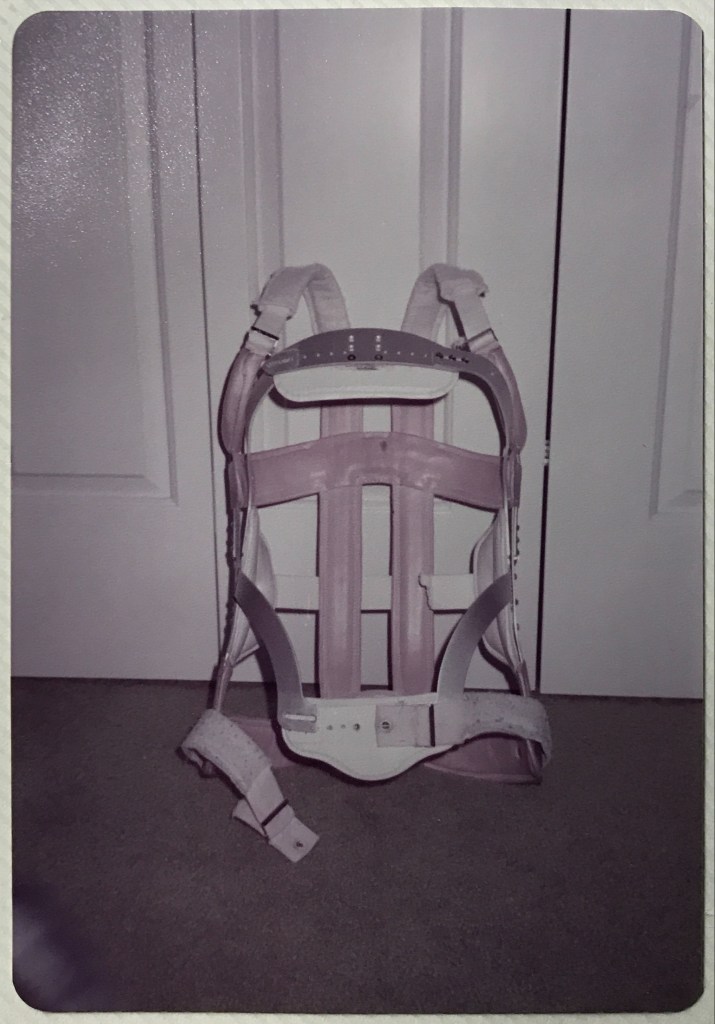
The second method Dr. Harrison recommended was a Milwaukee Brace. This brace would extend from my hips to my chest, with a neck brace that would extend up the back brace (think of the girl that Joan Cusak played in Sixteen Candles). There was one catch to the second method : I would have to wear the brace for four years. At the end of the four years of wearing the Milwaukee brace, there was a good possibility I might still need an operation.

My parents allowed me to make the choice between the two methods. In 9th grade, this was the hardest decision I had ever made.  Giving me the ability to make my own decision was a very empowering gift.  I chose the surgery.

On August 17, 1983 I had the surgery to correct my spine.  I am  told I was in a lot of pain.  I remember none it, except when the nurses stood me up for the first time, and also when I was sick on the morphine I was given for pain.  After eight days in the hospital, my back brace was put on.  I went home the next day.

I wore the back brace for three months. I think this was the hardest part of the whole process. Having always been a stomach sleeper, I had a hard time sleeping for the first few weeks. The brace, made of leather and steel made my body immobile from under my arms to my hips. the only part of my torso I could relax were my shoulders, thus creating a very bad habit that I am still trying to break.

“My Cage”
This is the back brace I wore for three months

Unfortunately, the brace was screwed on.  I, who was used to taking one to two showers daily, was limited to one shower a week. Every weekend, my father would unscrew the brace, and I was allowed out of it for one hour.  I was very fortunate because many people (at the time) who had my type of surgery were not able to have their back braces off for showers. Some people had to wear their brace for six months.

Having been a competitive swimmer from age six to age fourteen, I was not used to being inactive.  After the surgery, I was not able to do any physical activity, except walking, until February 1984.  At that point Dr. Harrison said I would be able to ride a bike and swim, but “I was not to get too tired”.  By June, a month after my 16th birthday, I was given the go ahead participate in everything I enjoyed.

I will never regret the decision I made. Having been given permission to make my own choice helped me grow into the person I have become.

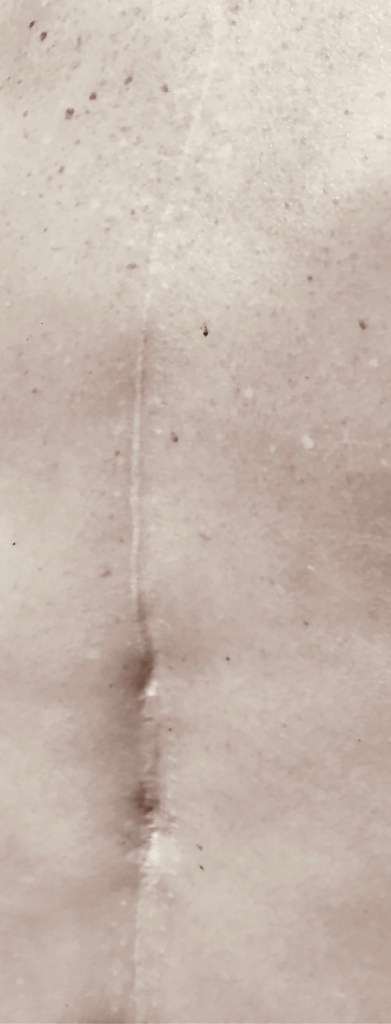
We all have scars, some visible, some internal. All our scars become a part of our story. A physical scar is like a road map to the past; the picture, is the scar that that tells part of the story I just shared.